Black Friday is 20 days away, and the biggest shopping weekend of the year is no longer won by the loudest discount. For Black Friday and Cyber Monday 2026, small businesses face rising competition, earlier shoppers, and a new habit: customers asking AI assistants for gift ideas and deals before they ever see an ad.
The good news is that a small team can still compete. A clear plan, a protected margin, and a few well-timed campaigns often beat a scattered, last-minute blast. This guide gives you a practical small business marketing plan you can start today.
You will learn how to set profit-safe goals, build a 20-day countdown, get found in AI shopping tools, design offers, and measure results. If you are still building your store’s traffic base, start with our guide to driving traffic to a new e-commerce store, then return here.
- Why Black Friday and Cyber Monday 2026 Look Different for Small Businesses
- Step 1: Set Profit-Safe Goals Before You Announce a Single Discount
- Step 2: Build Your 20-Day Countdown Calendar
- Step 3: Get Found in AI Shopping Tools and Search
- Step 4: Design Offers That Protect Your Margins
- Step 5: Turn Email and SMS Into Your Highest-Return Channel
- Step 6: Use Social Media to Build Demand, Not Just Post Deals
- Step 7: Run Paid Ads With Tight Budgets and Clear Rules
- Step 8: Prepare Your Website, Checkout and Fulfillment
- Step 9: Win Small Business Saturday With a Local and Community Angle
- Email Subject Lines and Messages That Cut Through Holiday Inbox Noise
- Common Black Friday Mistakes Small Businesses Should Avoid
- How to Measure Results and Keep Customers After Cyber Monday
- Frequently Asked Questions
- When should small businesses start Black Friday marketing?
- How much should I discount on Black Friday?
- Is Cyber Monday still worth it for small businesses?
- How can I get my products recommended by AI shopping tools?
- What is the best channel for Black Friday marketing on a small budget?
- Should I use SMS for holiday sales?
- Conclusion: Start Your Black Friday and Cyber Monday 2026 Plan Today
Why Black Friday and Cyber Monday 2026 Look Different for Small Businesses
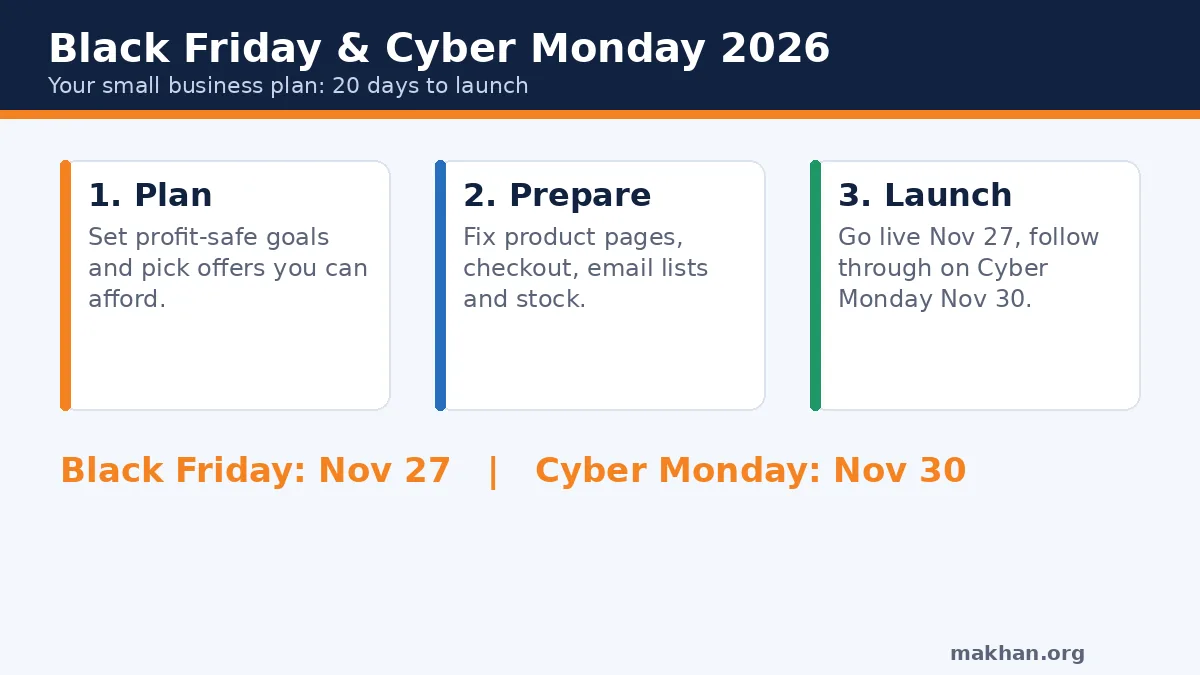
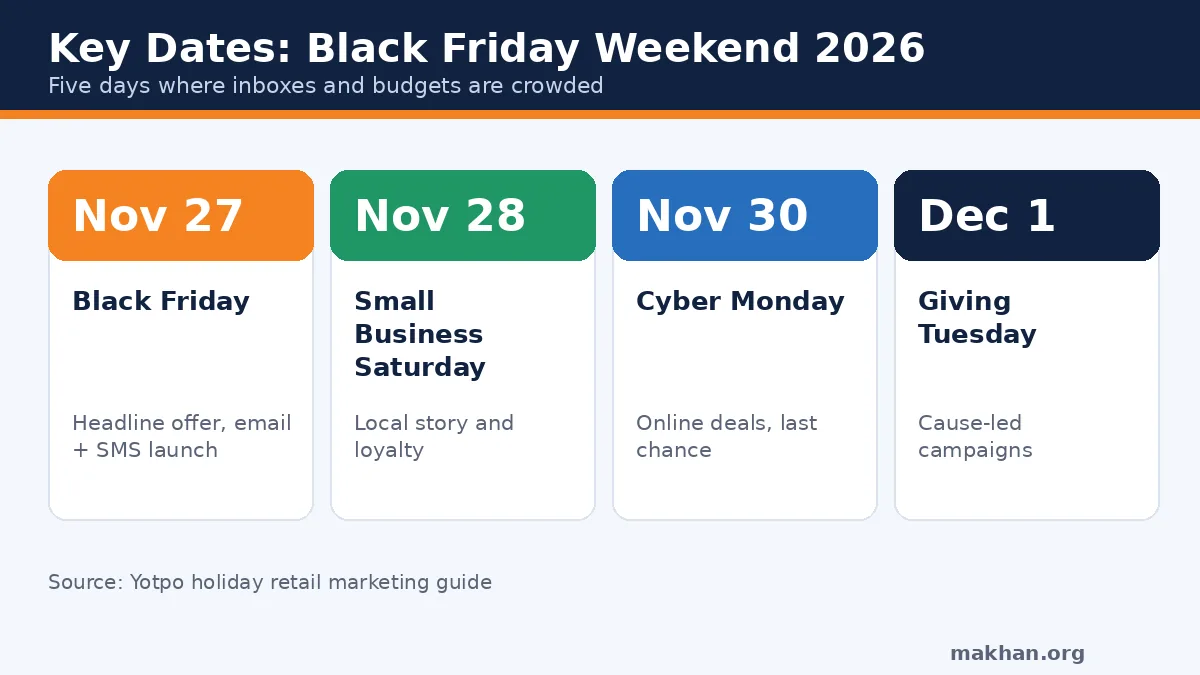
Dates first. Black Friday lands on November 27, Small Business Saturday on November 28, Cyber Monday on November 30, and Giving Tuesday on December 1, according to Yotpo’s holiday retail marketing guide. That gives you a five-day window where attention, budgets, and inboxes are all crowded.
| Date (2026) | Event | Best use for a small business |
|---|---|---|
| Nov 27 | Black Friday | Headline offer, email and SMS launch, retargeting |
| Nov 28 | Small Business Saturday | Local-first story, community, and loyalty messaging |
| Nov 30 | Cyber Monday | Online-only deals, bundles, last-chance reminders |
| Dec 1 | Giving Tuesday | Cause-based campaigns, thank-you messaging |
Demand remains strong. Adobe reported that shoppers spent $257.8 billion online with U.S. merchants during the 2025 holiday season, up 6.8%, as summarized by Practical Ecommerce. The same analysis predicts roughly 8% online growth for 2026, though that is a forecast, not a promise.
The AI shopping shift
AI tools are now part of the buying journey. Adobe data cited in the same article found AI-referred shoppers converted 31% better than other traffic during the 2025 holiday season and 38% better on Black Friday. Volume is still small compared with search and social, but the visitors are often further along in their decision.
What does that mean for you? Your product pages, reviews, and business details need to be clear enough for both people and machines. We cover that in Step 3. For wider context on this trend, see how AI search is changing SEO.
Step 1: Set Profit-Safe Goals Before You Announce a Single Discount
Many small businesses lose money on Black Friday because they chase revenue instead of profit. A sale that doubles orders but wipes out margin leaves you busier and poorer.
Start with three numbers before you design any offer:
- Gross margin per product: price minus product cost, shipping, packaging, and payment fees.
- Maximum discount: the deepest cut each product can take while still earning a positive contribution.
- Target outcome: orders, revenue, and new email subscribers you want by December 1.
Cash flow matters just as much. Stock purchases and ad spend leave your account weeks before the money returns. Our explanation of cash flow versus profit shows why a profitable sale can still strain your bank balance.
A simple margin check
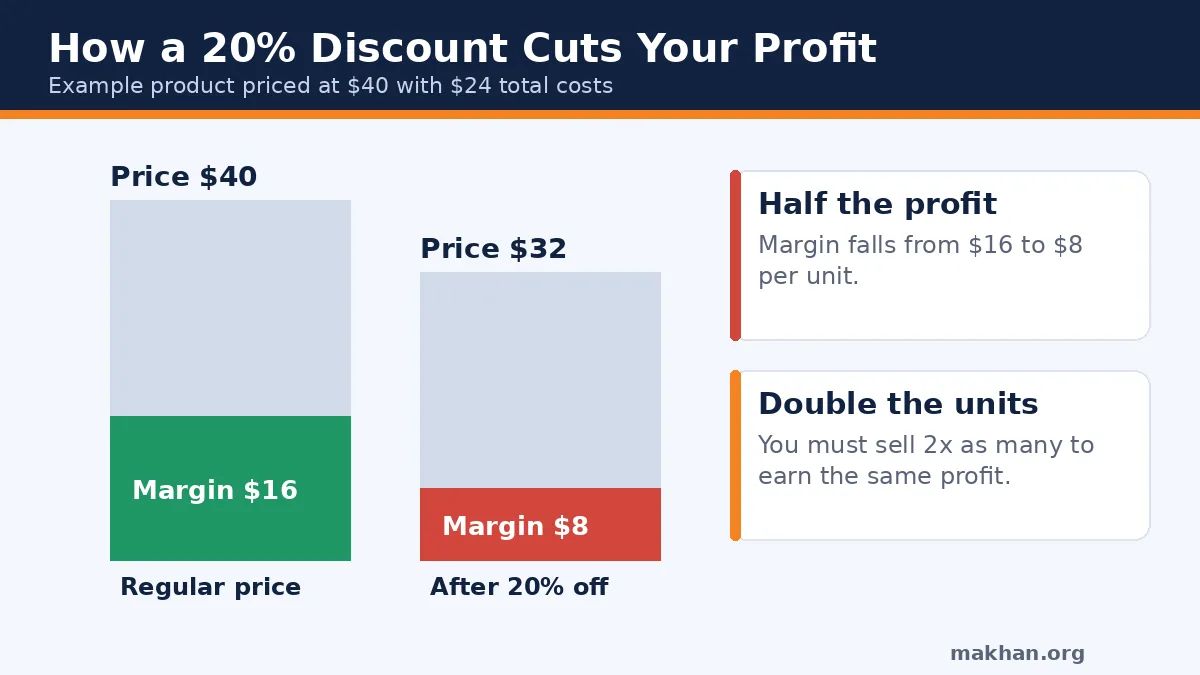
Take one product priced at $40 with total costs of $24. Your margin is $16. A 20% discount drops the price to $32 and your margin to $8, so you need to sell twice as many units just to earn the same profit. Run this math for every item before you promise a percentage.
If the numbers look tight, discount fewer products, use bundles, or offer a gift instead of a price cut. We explore these options in Step 4.
Step 2: Build Your 20-Day Countdown Calendar
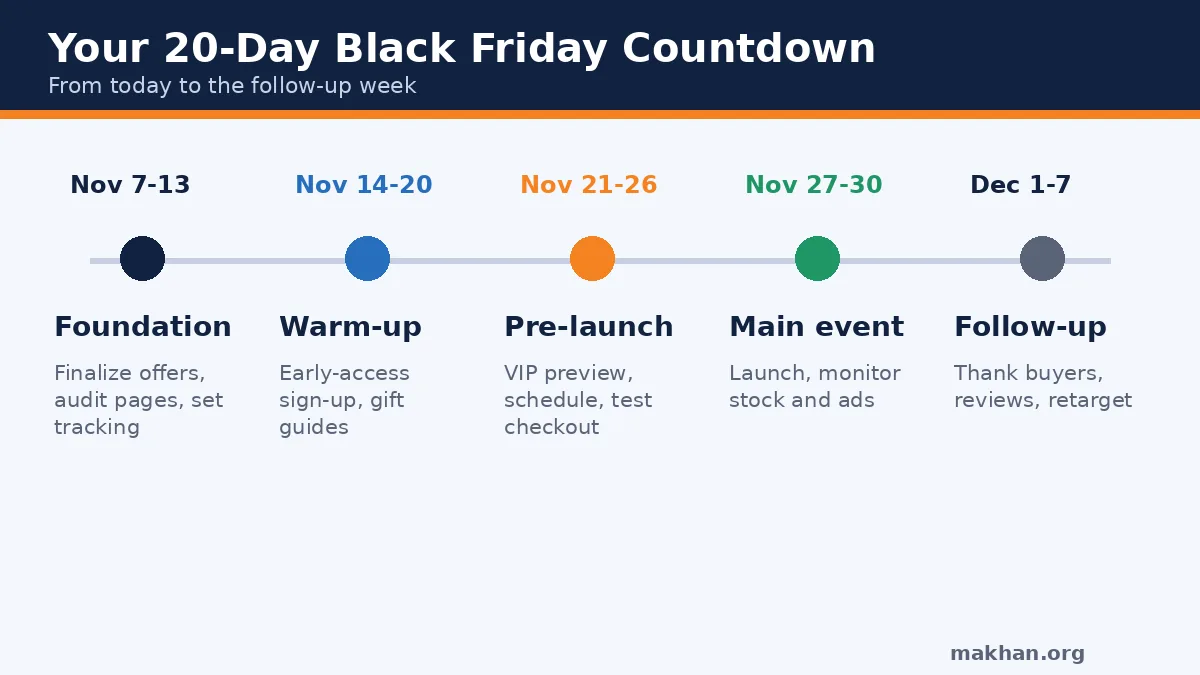
Shoppers increasingly start early, so waiting until Black Friday morning to speak up is a mistake. A countdown gives you time to build an audience, test messages, and fix problems before traffic peaks.
| Window | Focus | Key actions |
|---|---|---|
| Nov 7–13 | Foundation | Finalize offers, audit product pages, fix site speed, set up tracking |
| Nov 14–20 | Warm-up | Launch early-access sign-up, tease deals, publish gift guides |
| Nov 21–26 | Pre-launch | Send VIP preview, schedule posts and emails, test checkout |
| Nov 27–30 | Main event | Launch offers, monitor stock and ads daily, and answer questions fast. |
| Dec 1–7 | Follow-up | Thank buyers, request reviews, retarget browsers, plan retention |
Use scheduling software so your posts go out while you handle orders. Our roundup of social media scheduling tools can help you pick one that suits a small team.
Assign one owner to each task, even if the team is only two people. Clear ownership prevents the most common holiday failure: everyone assumes someone else fixed the checkout.
Step 3: Get Found in AI Shopping Tools and Search
AI assistants answer shopping questions by pulling from product pages, reviews, and trusted sources. Yotpo reported that AI-referred traffic to e-commerce sites grew 752% year over year during Black Friday–Cyber Monday 2025, though that figure comes from a vendor guide and starts from a small base.
You cannot control what an AI tool recommends, but you can make your store easy to understand. These steps support both classic search and AI discovery.
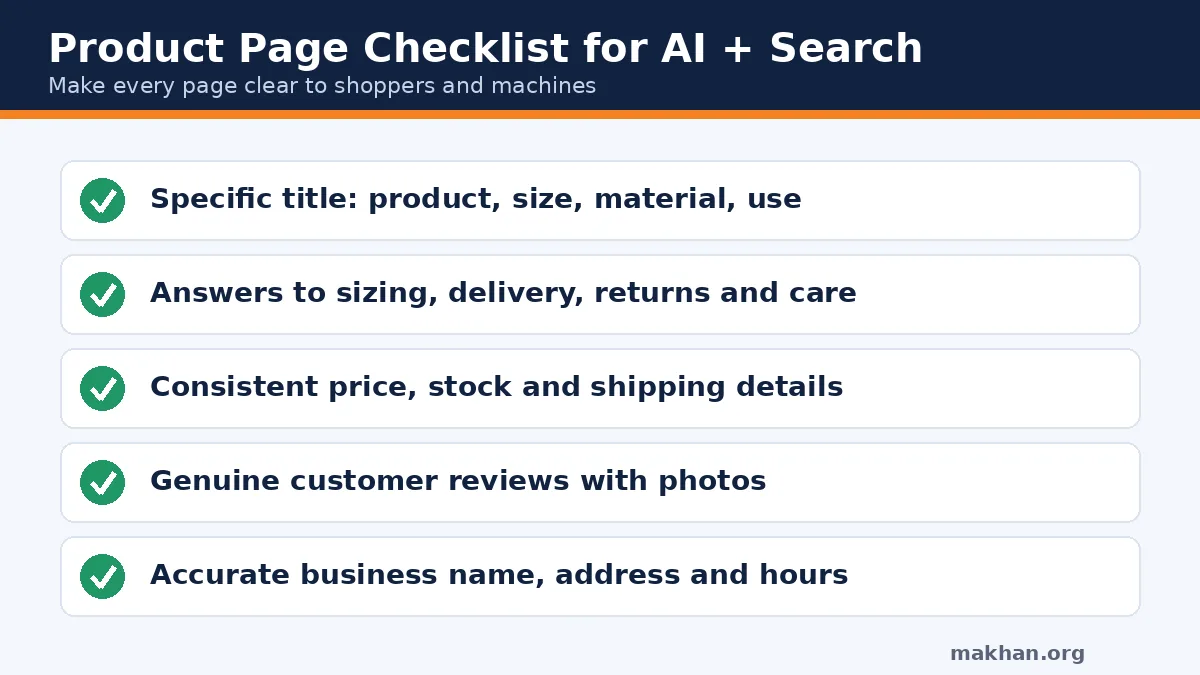
Make product pages clear and complete.
- Write specific titles that name the product, size, material, or use case.
- Answer common questions on the page: sizing, delivery times, returns, and care.
- Keep prices, stock status, and shipping details consistent everywhere you sell.
- Add genuine customer reviews with photos where possible.
Strengthen your business signals.
Search and AI tools both reward trusted, consistent businesses. Claim and update your Google Business Profile if you serve a local area, and keep your name, address, and hours identical across directories. Our article on building a local brand that AI trusts goes deeper.
Publish helpful gift content
Create two or three guides that match real shopper questions, such as “gifts under $50” or “best gifts for new homeowners.” Link each guide to the relevant products. A clear e-commerce content strategy keeps these pages useful long after Cyber Monday.
Finally, check how your store appears. Search your top products in ChatGPT, Gemini, and Google, and note which details are wrong or missing. Fix those pages first.
A quick test helps. Ask an AI assistant questions your customers might ask, such as “best gift for a coffee lover under $40,” and see whether your category appears. If it does not, compare your product pages with the ones that do. Look for gaps in detail, reviews, or clarity, and close them before November 27.
Step 4: Design Offers That Protect Your Margins
A strong offer is simple enough to explain in one sentence. Confusing coupon rules lower conversions and increase support emails.
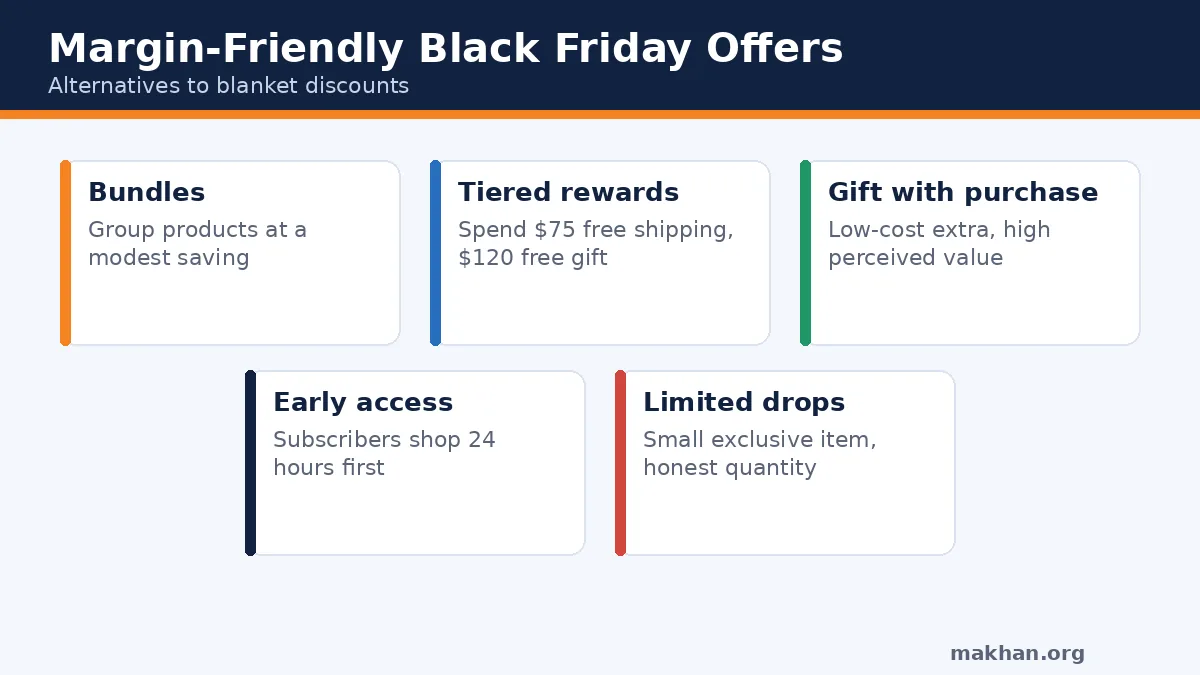
Consider these margin-friendly alternatives to blanket discounts:
- Bundles: group complementary products at a modest saving to lift average order value.
- Tiered rewards: “Spend $75, get free shipping; spend $120, get a gift.”
- Gift with purchase: add a low-cost, high-perceived-value extra instead of cutting price.
- Early access: let subscribers shop 24 hours before everyone else.
- Limited stock drops: release a small, exclusive item with an honest quantity.
Be honest about urgency.
Real deadlines work. Fake countdown timers and invented scarcity damage trust and may breach consumer protection rules in some regions. If stock is limited, say exactly how many units remain. If an offer ends Monday at midnight, make sure it actually does.
Protect your best customers.
Reward people who already buy from you. A small “thank you” code for past customers feels better than watching them pay more than a new shopper. This approach also supports the small business growth strategies that build lasting revenue rather than one-weekend spikes.
Step 5: Turn Email and SMS Into Your Highest-Return Channel
Your email list is an audience you own. Ad costs often rise during the holidays, but a message to a warm subscriber costs almost nothing. For many small stores, email becomes the most reliable Black Friday and Cyber Monday 2026 channel.
A five-message email sequence
- Teaser (Nov 18–20): announce that a sale is coming and invite people to join the early-access list.
- VIP preview (Nov 25–26): give subscribers first access and the best selection.
- Launch (Nov 27): send the main offer with one clear button.
- Reminder (Nov 29–30): highlight what is selling fast and what is ending soon.
- Last chance (Nov 30): send a short message in the final hours.
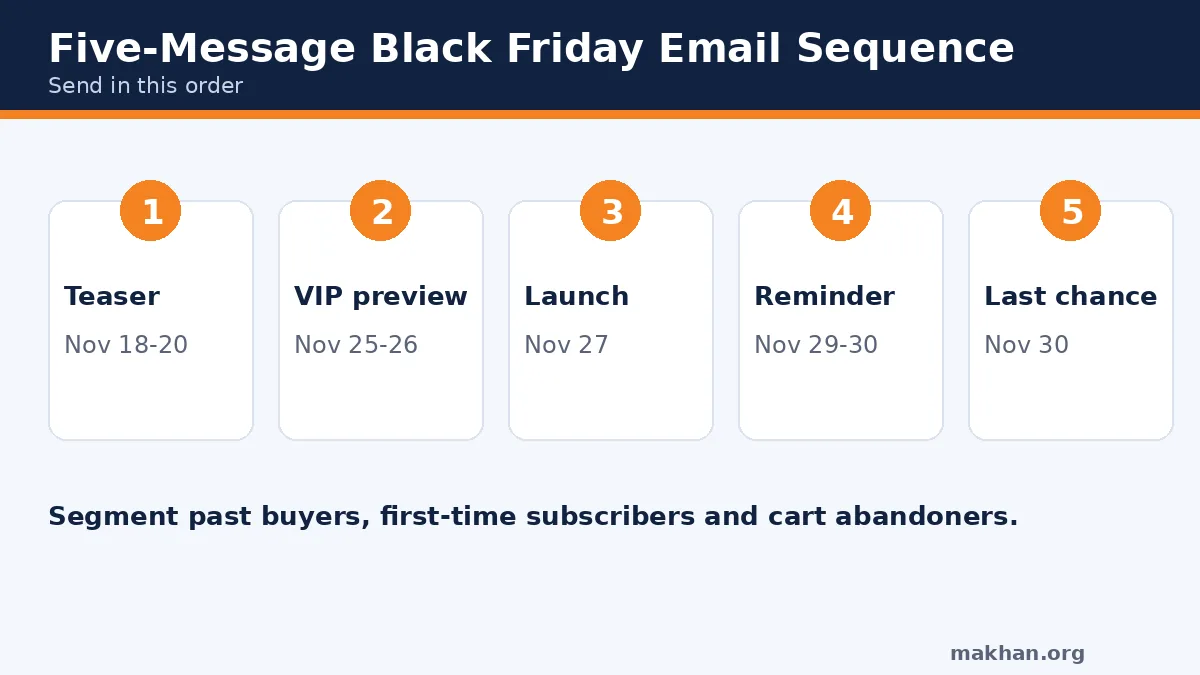
Segment where you can. Send past buyers a different message from first-time subscribers, and send cart abandoners a simple reminder. If you use Mailchimp, our Mailchimp automation guide walks through the workflows, and our list of best email autoresponders compares alternatives.
Use SMS carefully
Text messages get seen quickly, but they also feel personal. Only message people who opted in, keep texts short, and limit them to genuinely useful moments such as launch day and final hours. Always include a clear way to opt out.
For larger workflows, consider the tools in our guide to marketing automation platforms, but keep the setup simple enough to test before November 27.
Step 6: Use Social Media to Build Demand, Not Just Post Deals
Social platforms now work as search engines too. People look up gift ideas and reviews on Instagram, TikTok, and YouTube, so your content should answer questions, not only announce discounts.
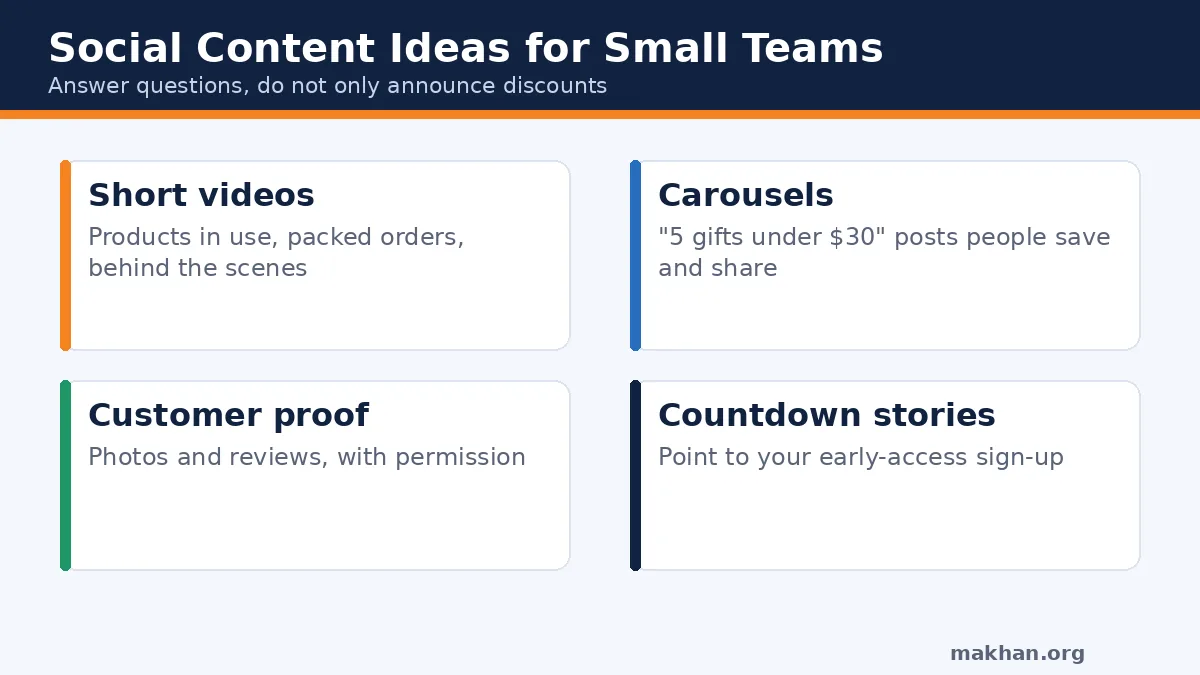
Content ideas that work for small teams
- Short videos showing products in use, packed orders, or behind-the-scenes preparation.
- Carousel posts such as “5 gifts under $30” that people can save and share.
- Customer photos and reviews, with permission.
- Countdown stories that point to your early-access sign-up.
Include natural keywords in captions and add descriptive alt text to images so your posts are easier to find. If Instagram is a key channel, our guide to selling on Instagram covers shops, product tags, and checkout basics.
Respond quickly in comments and messages. During a sale, a fast reply often decides whether a hesitant shopper buys. Also review our list of common social media mistakes so you avoid posting too much, ignoring comments, or sounding like every other brand.
Step 7: Run Paid Ads With Tight Budgets and Clear Rules
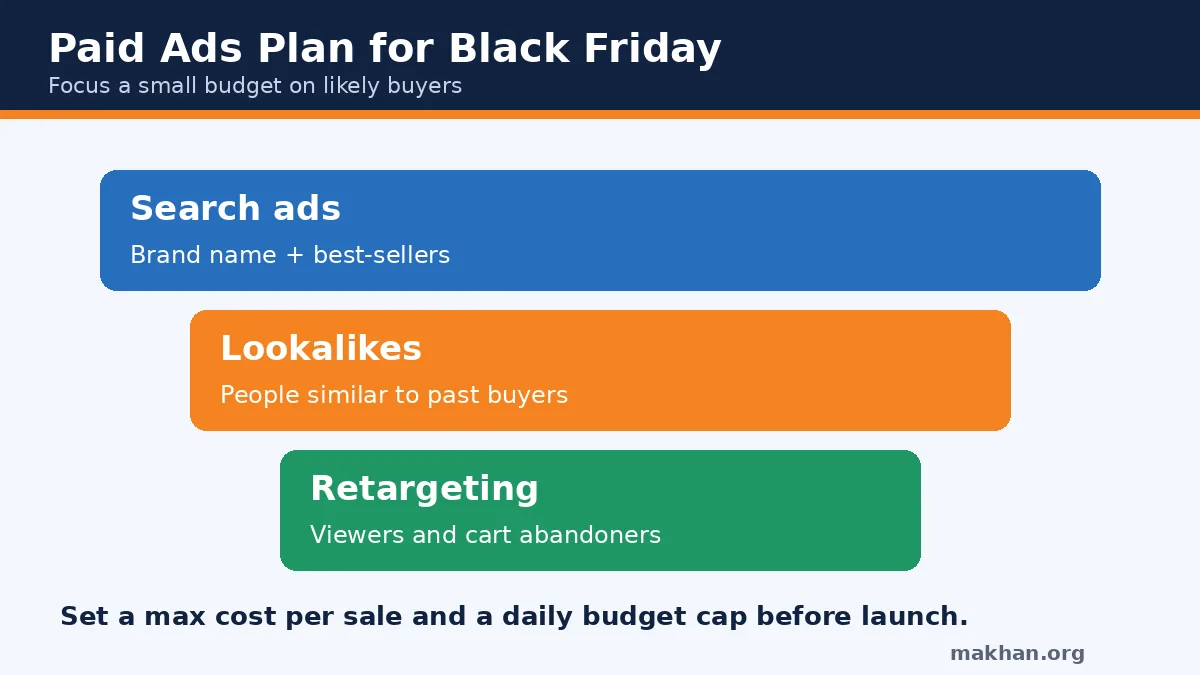
Paid ads cost more during peak weeks, so structure matters. Rather than spreading a small budget thin, focus on the audiences most likely to buy.
- Retargeting: show reminders to people who viewed products or abandoned carts.
- Customer lookalikes: reach people similar to your past buyers.
- Search ads: bid on your brand name and your best-selling product terms.
Set rules before you spend
Decide in advance your maximum cost per sale and your daily budget cap. If a campaign passes the limit, pause it. Review performance each morning during the main event and move money toward ads that sell at a profit.
Creative matters as much as targeting. Use a simple, honest message that states the offer, the deadline, and the main benefit. Test two or three versions with small budgets in the days before launch, then put your money behind the winner when traffic peaks.
New to paid social? Our Facebook ad strategy for beginners explains campaign setup, audiences, and testing in plain language.
Step 8: Prepare Your Website, Checkout and Fulfillment
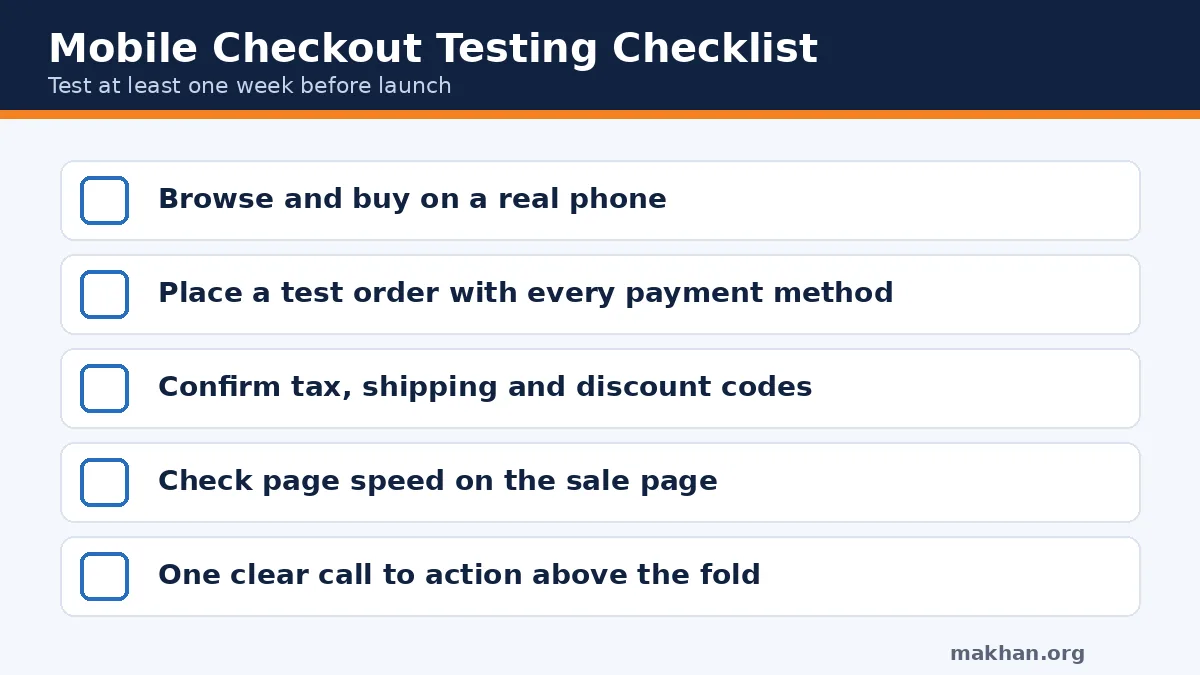
The best campaign fails if the site slows down or checkout breaks. Test everything at least one week before launch.
Website readiness checklist
- Test your site on a phone, since many holiday shoppers browse and buy on mobile devices.
- Compress images and review caching to keep pages fast. Our speed optimization plugin comparison can help WordPress owners.
- Place a single clear call to action above the fold on your sale page.
- Place a test order using every payment method you offer.
- Confirm tax, shipping rates, and discount codes calculate correctly.
Practical Ecommerce also expects buy-now-pay-later services to finance more than $22 billion of U.S. online holiday purchases in 2026. If your platform supports installment payments, consider offering them on higher-priced items, after checking fees and terms.
Fulfillment and customer service
Set realistic delivery dates and display them clearly. Update stock counts as you sell, and hide sold-out items quickly. Prepare short replies for common questions about shipping, returns, and order changes so one person can answer fast.
For deeper checkout and landing-page improvements, see our guide on conversion optimization.
Step 9: Win Small Business Saturday With a Local and Community Angle
Small Business Saturday on November 28 is your natural advantage. Big retailers cannot easily copy a personal story, a local connection, or a founder who answers messages themselves. Use that difference on purpose.
Tell the story behind the products
Share who makes your products, why you started, and what a purchase supports. A short founder video or a photo of your team packing orders feels more convincing than another discount banner. Keep it honest and specific, and avoid vague claims you cannot prove.
Offer something only you can offer
- Local pickup or same-day delivery for nearby customers.
- A handwritten note or personalised gift wrapping with each order.
- A partnership with a neighbouring business, such as a joint bundle or cross-promotion.
- A small donation per order to a cause your customers care about, announced clearly in advance.
If you run a shop or service area, update your opening hours online before the weekend and add holiday posts to your Google Business Profile. Accurate hours and photos prevent lost visits and give shoppers one more reason to trust you.
Email Subject Lines and Messages That Cut Through Holiday Inbox Noise
Inboxes are crowded in late November, so your subject line has one job: earn the open without tricking the reader. Clear beats clever, and specific beats vague.
- Teaser: “Our Black Friday offer starts Friday, get early access here.”
- VIP preview: “You are in: shop 24 hours before everyone else.”
- Launch: “Black Friday is live: bundles from $29.”
- Last chance: “Ends tonight at midnight: your cart is waiting.”
Keep the body short, put one button above the fold, and make sure the offer matches the subject line exactly. Preview every email on a phone and send yourself a test before scheduling. A broken link in a launch email wastes your most valuable send.
Common Black Friday Mistakes Small Businesses Should Avoid
Most holiday failures are preventable. Review this list with your team during the foundation week.
- Discounting without checking margins: high sales volume can still produce a loss.
- Starting too late: shoppers compare options early, and a cold audience takes time to warm up.
- Overcomplicated offers: if a customer needs a calculator, they will leave.
- Ignoring mobile: a clumsy phone checkout loses sales quietly.
- Running out of stock without warning: disappointed customers rarely return and often leave reviews.
- Slow support: unanswered questions during the sale become abandoned carts.
- No follow-up plan: the weeks after Cyber Monday are where loyalty is built.
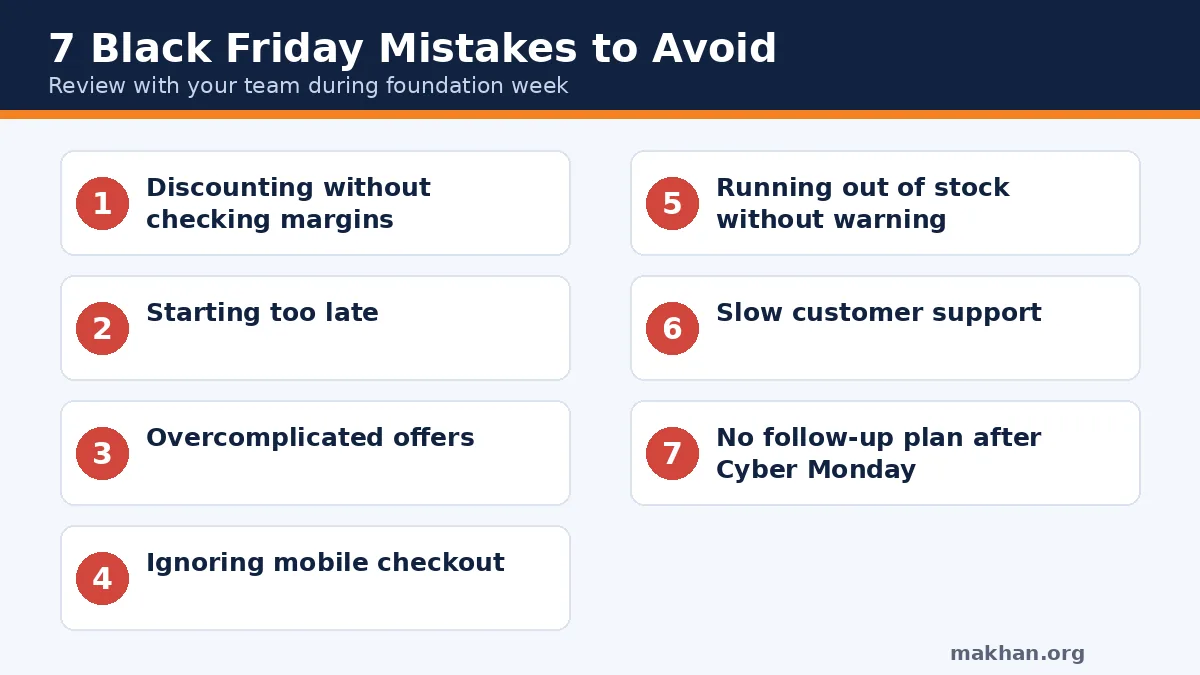
Build a one-page checklist from these points and review it again on November 26. Ten minutes of checking is cheaper than a weekend of firefighting.
How to Measure Results and Keep Customers After Cyber Monday
Track a handful of numbers rather than dozens. Revenue alone hides problems, so compare it with profit and cost.
| Metric | Why it matters |
|---|---|
| Conversion rate | Shows whether traffic turns into orders |
| Average order value | Reveals whether bundles and tiers are working |
| Cost per sale | Keeps ad spend within profit limits |
| New email subscribers | Measures audience growth beyond the sale |
| Repeat purchase rate | Tests whether new buyers return |
After December 1, send a thank-you email, request reviews, and invite new customers to join your regular list. Review what worked, record the dates and results, and save your campaign notes for next year. A written post-mortem is the cheapest way to improve your next Black Friday and Cyber Monday.
Frequently Asked Questions
When should small businesses start Black Friday marketing?
Start two to three weeks before Black Friday. Use the early weeks to collect early-access sign-ups, publish gift guides, and test emails. Many shoppers begin browsing well before the weekend, so a late start misses easy demand.
How much should I discount on Black Friday?
Only as much as your margin allows. Calculate the lowest profitable price for each product first. If discounts cut too deeply, use bundles, free shipping thresholds, or a gift instead.
Is Cyber Monday still worth it for small businesses?
Yes, especially for online stores. Cyber Monday works well for a second wave of offers, last-chance reminders, and bundles. Treat it as the closing chapter of one campaign rather than a separate sale.
How can I get my products recommended by AI shopping tools?
No one can guarantee recommendations. You can improve your chances by publishing clear product details, honest reviews, consistent business information, and helpful gift content. Then check how AI tools describe your products and correct gaps.
What is the best channel for Black Friday marketing on a small budget?
Email is usually the strongest low-cost channel because you reach people who already know you. Pair it with organic social content and a small retargeting budget for cart abandoners.
Should I use SMS for holiday sales?
Use SMS only with permission, and keep messages rare and useful. Launch-day and final-hours texts are enough for most stores. Always provide an easy opt-out.
Conclusion: Start Your Black Friday and Cyber Monday 2026 Plan Today
A strong Black Friday and Cyber Monday 2026 campaign comes down to preparation. Set profit-safe goals, follow a 20-day countdown, make your store easy for people and AI tools to understand, and lean on email before expensive ads.
Pick one task from Step 1 and finish it today. Then open our guide to AI in digital marketing to see which AI tools are worth your time, and share this plan with your team so everyone knows their part.