AI search is changing how people discover information, compare solutions, and decide which websites deserve their attention. Google’s Search Generative Experience (SGE)—the experimental name that helped introduce this shift—and today’s AI-powered search experiences, alongside ChatGPT search, can answer questions directly, summarize information, and point users to selected sources. For website owners, the challenge is no longer just earning a blue link: it is creating content that deserves to be found, understood, cited, and visited.
This does not mean traditional SEO is dead. It means the strongest strategy combines technical accessibility, helpful content, topical depth, clear brand signals, and measurement that reflects more than rankings alone. If you are strengthening your foundation, start with our guides to keyword research in 2026 and AI in digital marketing; both help connect search intent with a useful content strategy.
- What Are AI Search and SGE?
- How AI Search Is Changing SEO
- 1. Visibility is broader than a traditional ranking.
- 2. Clicks may become less predictable.
- 3. Search intent matters more than repeating a phrase.
- 4. Original insight becomes a competitive advantage.
- 5. Brand trust and entity clarity are more important.
- 6. Topical depth beats a pile of disconnected posts.
- What Remains the Same: SEO Fundamentals
- How to Optimize Content for Google AI Overviews and ChatGPT Search
- Technical and Editorial Checklist for AI Search
- Common AI SEO Mistakes to Avoid
- How to Measure Success in AI Search
- The Future of SEO in an AI-Driven Search World
- Conclusion: Build for Discovery, Trust, and Usefulness
- Frequently Asked Questions
What Are AI Search and SGE?
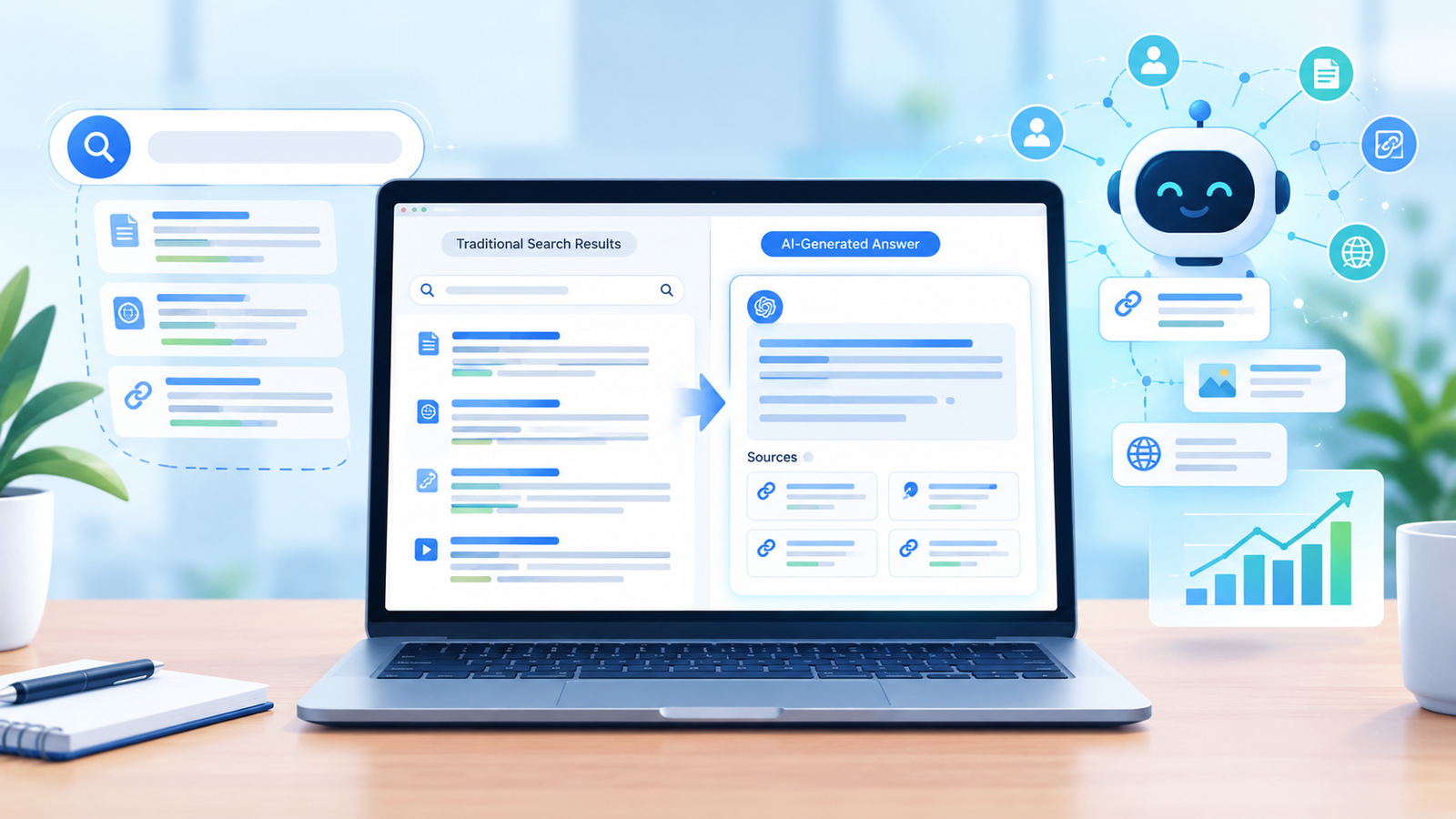
AI search uses artificial intelligence to interpret a question, retrieve relevant information, and present a synthesized response. Rather than showing only a list of links, an AI experience may offer a short overview, supporting citations, suggested follow-up questions, or a conversational answer.
Google’s SGE was an early experimental label. Google’s current experiences include AI Overviews and AI Mode, while ChatGPT offers search features that can include linked web sources. These products differ in how they retrieve information and display citations, so it is better to understand the shared shift than treat them as identical systems.
How AI search differs from classic search
- Classic search: users enter a query and choose from ranked pages, snippets, videos, images, or other results.
- AI-powered search: users may receive a synthesized answer first, with links to sources and options to continue exploring.
- Conversational discovery: people can ask follow-up questions, add constraints, and refine a task without starting from scratch.
AI systems may combine multiple related searches and sources to respond to a complex query. That creates opportunities for pages that answer a specific sub-question well, even when the page is not written around the exact wording of the initial query. It also makes clarity, factual accuracy, and distinct value especially important.
How AI Search Is Changing SEO

1. Visibility is broader than a traditional ranking.
A page can earn value when it is linked from an AI response, quoted as a source, surfaced in an overview, or discovered through a follow-up question. These appearances are not guaranteed, and each platform reports visibility differently. Still, SEO teams should think about being a useful source across the discovery journey, not only holding one position for one keyword.
2. Clicks may become less predictable.
When a search interface answers a basic question immediately, some users may not need to click through. For other searches, a useful overview can help users understand a topic and encourage them to visit a source for details, tools, evidence, or a deeper explanation. The impact varies by query, industry, interface, and user intent; avoid assuming that every site will lose traffic or that every AI placement will send more visitors.
Track impressions, clicks, click-through rate, conversions, assisted conversions, branded searches, and engagement together. Our guide on diagnosing high impressions but low clicks in Google Search Console can help you investigate changing search performance rather than reacting to one metric.
3. Search intent matters more than repeating a phrase.

People ask natural, detailed questions: “Which project management tool works for a five-person agency?” or “How can I improve local visibility without a large budget?” A page that understands the real task and answers it with useful detail is more valuable than a page that repeats an exact keyword without solving the problem.
Use keyword research to understand the language people use, then organize content around needs, decisions, and related questions. Include the main topic naturally in the title, introduction, headings, and relevant copy, but do not force awkward repetition.
4. Original insight becomes a competitive advantage.
AI systems can summarize information already available across the web. If your page repeats the same generic advice as dozens of competitors, it gives readers—and retrieval systems—little reason to choose it. Add original analysis, real examples, tested processes where you genuinely tested them, expert commentary, first-party data, diagrams, or a clear point of view.
Never invent surveys, statistics, client results, or personal experience to make content look original. If you do not have original research, you can still add value through a carefully explained workflow, transparent comparisons, practical templates, and synthesis that helps readers make a decision.
5. Brand trust and entity clarity are more important.

Search systems need to understand who publishes a page, what the organization does, and why the content is relevant. Consistent business details, clear author information, accurate profiles, credible mentions, and helpful pages about your expertise all support a coherent picture of the brand.
For a local business, review your business details and reputation across the places customers actually use. Our guide on building a local brand that AI trusts explores how clear identity and trustworthy information can support discoverability.
6. Topical depth beats a pile of disconnected posts.
A single article rarely answers every question in a subject area. Build a logical content cluster: a comprehensive guide supported by focused pages on related tasks, comparisons, definitions, troubleshooting, and examples. Link those pages together where it helps readers continue learning.
Internal links help people and crawlers discover related content and understand how pages connect. Use descriptive anchor text that explains the destination, and link only when the destination is genuinely relevant. Avoid creating dozens of near-identical pages solely to target tiny variations of the same query.
What Remains the Same: SEO Fundamentals

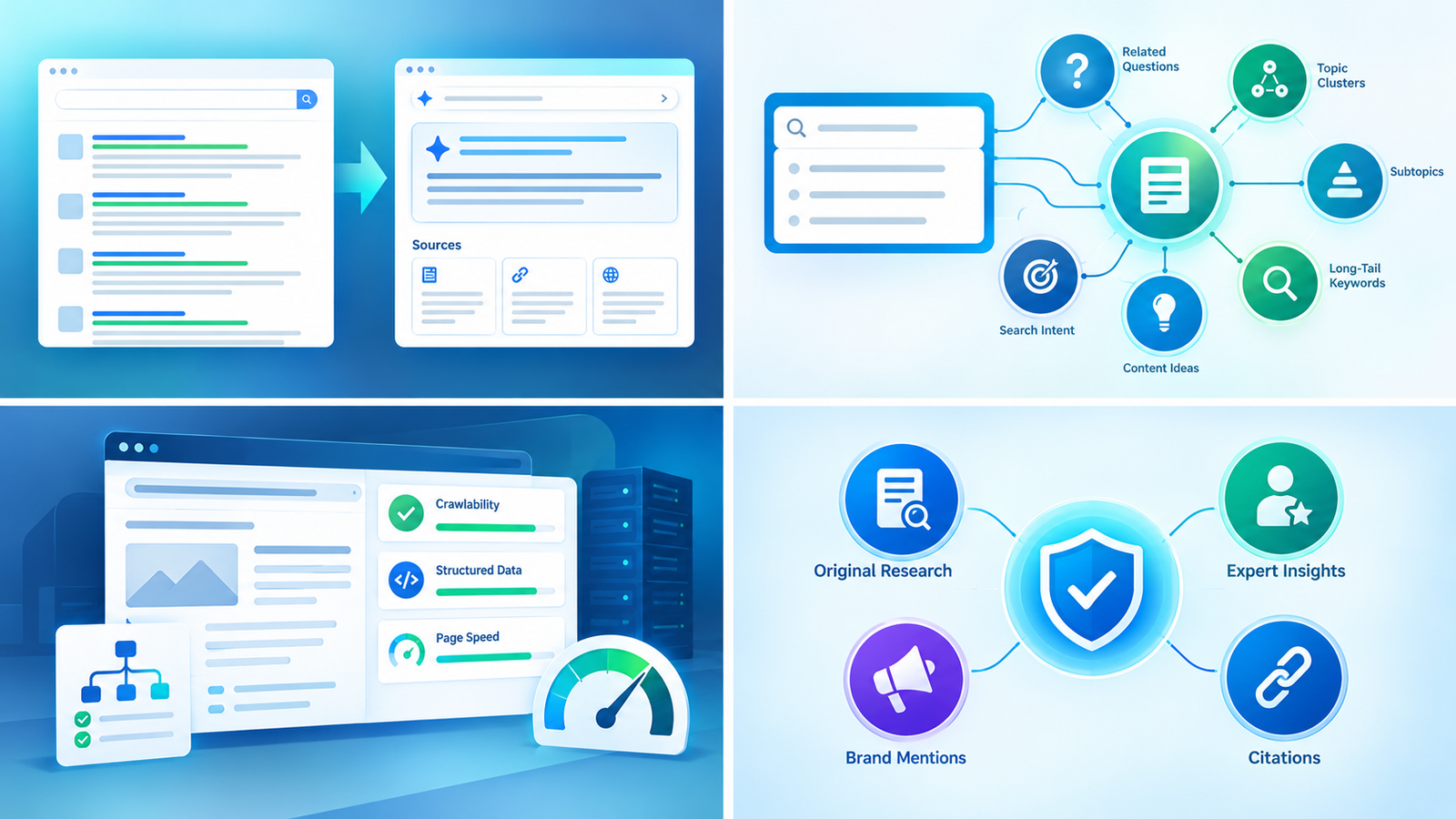
Google’s published guidance says the existing SEO fundamentals remain relevant for its AI search features. There is no guaranteed special markup, secret AI file, or single optimization that guarantees inclusion. A page must still be accessible and eligible for search, and eligibility does not guarantee that it will be crawled, indexed, or shown.
- Crawlability: make sure important pages are not accidentally blocked by robots.txt, authentication, or infrastructure rules.
- Indexability: use appropriate canonical tags and noindex directives; check that pages intended for search can be indexed.
- Useful internal links: connect important pages through relevant contextual links.
- Helpful page experience: make the site readable, mobile-friendly, reasonably fast, and easy to navigate.
- Accessible content: ensure important information is available as text, not only inside an image or inaccessible interface.
- Accurate structured data: use schema that reflects visible page content; do not add unsupported or misleading markup.
- Good media: use relevant, high-quality images and video when they improve understanding, with meaningful alt text.
These are not outdated chores. They help search systems reach and interpret your content and help visitors use it once they arrive.
How to Optimize Content for Google AI Overviews and ChatGPT Search
1. Answer the main question early.
Open with a direct answer that matches the search intent. Follow it with context, caveats, examples, and details. Do not bury the answer beneath a long story or a series of generic statements. A clear opening helps readers decide quickly whether the page addresses their need.
2. Structure pages for scanning
Use one clear H1, descriptive H2 sections, and H3s for supporting points. Keep paragraphs focused, explain unfamiliar terms, and use lists or tables when they make comparisons easier. Structure is for human understanding first; there is no magic paragraph length or “AI chunking” formula that guarantees visibility.
3. Cite credible evidence.
Link to primary sources for important claims, such as official documentation, research papers, government resources, or original datasets. Clearly distinguish verified facts from recommendations and opinions. Review dates, product features, legal requirements, and statistics before publishing, especially on topics that change quickly.
4. Make the author and publisher clear.
Provide accurate author biographies, relevant experience, editorial standards, and contact information where appropriate. If you publish reviews or comparisons, explain the criteria used. Trust is built through consistency and evidence—not by adding empty phrases such as “expert-approved” without support.
5. Use examples, visuals, and original assets.

Show a process, decision tree, comparison, or worked example when it makes a concept easier to understand. Give each meaningful image descriptive alt text that communicates what the image shows. Do not stuff keywords into alt attributes or use decorative images simply to hit an arbitrary count.
6. Keep the content fresh when the subject changes.
Update information when product features, platform guidance, prices, or processes change. A visible update date should reflect a meaningful review, not an automatic date change. Remove outdated claims and check all links as part of maintenance.
7. Make sure ChatGPT search can discover your site.
OpenAI documents the role of OAI-SearchBot surfacing websites in ChatGPT search. Review your robots.txt rules and hosting or CDN settings so you understand whether the crawler can access pages you want discovered. OpenAI distinguishes OAI-SearchBot, used for search, from GPTBot, which is associated with potential model training; site owners should review the official documentation before changing crawler rules.
Official resources: Google Search Central: AI features and your website, OpenAI: Overview of OpenAI crawlers, and OpenAI: Publishers and Developers FAQ.
Technical and Editorial Checklist for AI Search
Use this practical checklist when reviewing an important page:
- Confirm the page returns a successful response and is accessible to the intended crawlers.
- Check indexability, canonicalization, and internal links.
- Write a title and description that accurately represent the page and encourage the right click.
- Answer the core query directly, then cover useful related questions.
- Add distinct value through evidence, expertise, examples, or original explanation.
- Check names, dates, statistics, citations, and outbound links.
- Use relevant images with accurate alt text and optimize file size.
- Validate structured data against the visible page content.
- Link to related pages using natural, descriptive anchor text.
- Measure performance and conversions, then update the page based on evidence.
Common AI SEO Mistakes to Avoid
- Chasing a shortcut: no prompt, schema snippet, or special file guarantees citations in AI responses.
- Publishing at scale without value: large volumes of lightly edited, repetitive content can create quality and spam-policy risks.
- Writing for a machine instead of a reader: forced keyword repetition and unnatural sections make pages less useful.
- Ignoring classic SEO: AI search does not remove the need for crawlability, indexability, internal links, and strong content.
- Inventing authority: fake credentials, fabricated data, and unsupported claims damage trust.
- Measuring only rankings: evaluate visibility alongside relevant visits, leads, sales, and user engagement.
- Assuming every AI platform behaves alike: Google Search and ChatGPT have different systems, interfaces, and reporting options.
How to Measure Success in AI Search

Start with a baseline. Record organic impressions and clicks for important pages, the queries they serve, conversion events, and branded search activity. Review analytics for changes in landing-page quality and business outcomes. Where platform reporting is available, examine AI-related appearances or referrals, but remember that attribution can be incomplete and platform definitions may change.
Use a small set of representative topics to test improvements rather than relying on a few anecdotal AI answers. Monitor the pages that matter, note changes over time, and avoid concluding one search session. If impressions rise while clicks fall, investigate query mix, search layout, intent, and conversion quality before rewriting the entire page.
The Future of SEO in an AI-Driven Search World
Search is becoming more conversational and more capable of combining information across sources. The interface may continue to evolve, but the long-term task for publishers is familiar: publish information that genuinely helps a defined audience, make it technically accessible, demonstrate credibility, and give people a good reason to visit your site.
For businesses and creators, the opportunity is to become a trusted source for a specific set of problems. Build a connected library of useful content, keep facts accurate, make your expertise visible, and measure outcomes rather than chasing every new acronym. SEO will keep changing, but useful content and sound technical foundations remain a durable strategy.
Conclusion: Build for Discovery, Trust, and Usefulness
AI search is changing how answers are presented and how websites earn attention, but it has not made SEO irrelevant. Google’s AI experiences and ChatGPT search create discovery paths while still relying on accessible, relevant information and useful sources. There is no guaranteed formula for being cited; focus instead on quality, clarity, originality, crawlability, and a strong experience for the people you serve.
To put these principles into practice, revisit our guide to AI in digital marketing, refine your plan with keyword research best practices, and strengthen brand credibility using the local brand trust guide. Connect relevant articles with helpful anchor text, then measure whether your content attracts the right visitors and supports meaningful business goals.
Frequently Asked Questions
Is SEO dead because of AI search?
No. AI changes how search results are presented, but technical SEO, useful content, relevance, internal linking, and trust remain important. The strategy should adapt to discovery experiences rather than abandon search optimization.
What does SGE mean?
Search Generative Experience (SGE) was Google’s experimental name for an AI-enhanced search experience. Google’s current AI search experiences include AI Overviews and AI Mode.
How can my website appear in ChatGPT search?
Make your public pages useful, accessible, and clear, and review your robots.txt and server settings to ensure OAI-SearchBot is not unintentionally blocked. Inclusion and citations are not guaranteed.
Do I need special schema for AI Overviews?
No special schema guarantees inclusion in Google AI search features. Use structured data only when it accurately describes the visible content and follow established SEO best practices.
Should I create separate pages for every AI-generated query?
No. Build pages around real user needs and distinct search intent. Avoid producing large numbers of near-duplicate pages just to target query variations.