Publishing more articles does not automatically make a website an authority. A site can target hundreds of keywords and still struggle to earn consistent visibility if its pages are disconnected, its coverage is shallow, or its content wanders across unrelated subjects. A stronger approach is to build a useful body of information around a subject your audience cares about.
Topical authority in SEO describes the recognition a website earns when it consistently demonstrates relevant, trustworthy knowledge across a subject and the questions connected to it. It is not a badge Google awards, a score you can switch on, or a single confirmed ranking factor. It is a strategic outcome: visitors find useful answers, the pages fit together logically, and the site shows a credible understanding of the topic.
This practical guide explains how to choose a focused subject, research its subtopics, map existing content, build pillar and supporting pages, connect them with internal links, demonstrate trust, and measure progress. The approach is useful for bloggers, publishers, consultants, small businesses, and content teams that want to build sustainable search visibility rather than publish for volume alone.
- What Is Topical Authority in SEO?
- Why Topical Authority Matters
- How to Build Topical Authority: 10 Practical Steps
- Step 1: Choose a focused topic that fits your website.
- Step 2: Understand the audience’s search journey
- Step 3: Research the full topic, not just the main keyword.
- Step 4: Analyze competitors for gaps, not for copying.
- Step 5: Build a topical map.
- Step 6: Audit existing content before creating more
- Step 7: Plan pillar pages and supporting content
- Step 8: Create genuinely useful, evidence-based content
- Step 9: Connect the cluster with contextual internal links
- Step 10: Demonstrate trust, build reputation, and maintain the cluster
- How to Measure Progress Without Chasing a Fake Authority Score
- Common Topical Authority Mistakes to Avoid
- Conclusion: Build a Useful Resource, Not Just a Larger Blog
- A Worked Example: Turning a Topic Into a Content Cluster
- Final Takeaway
What Is Topical Authority in SEO?
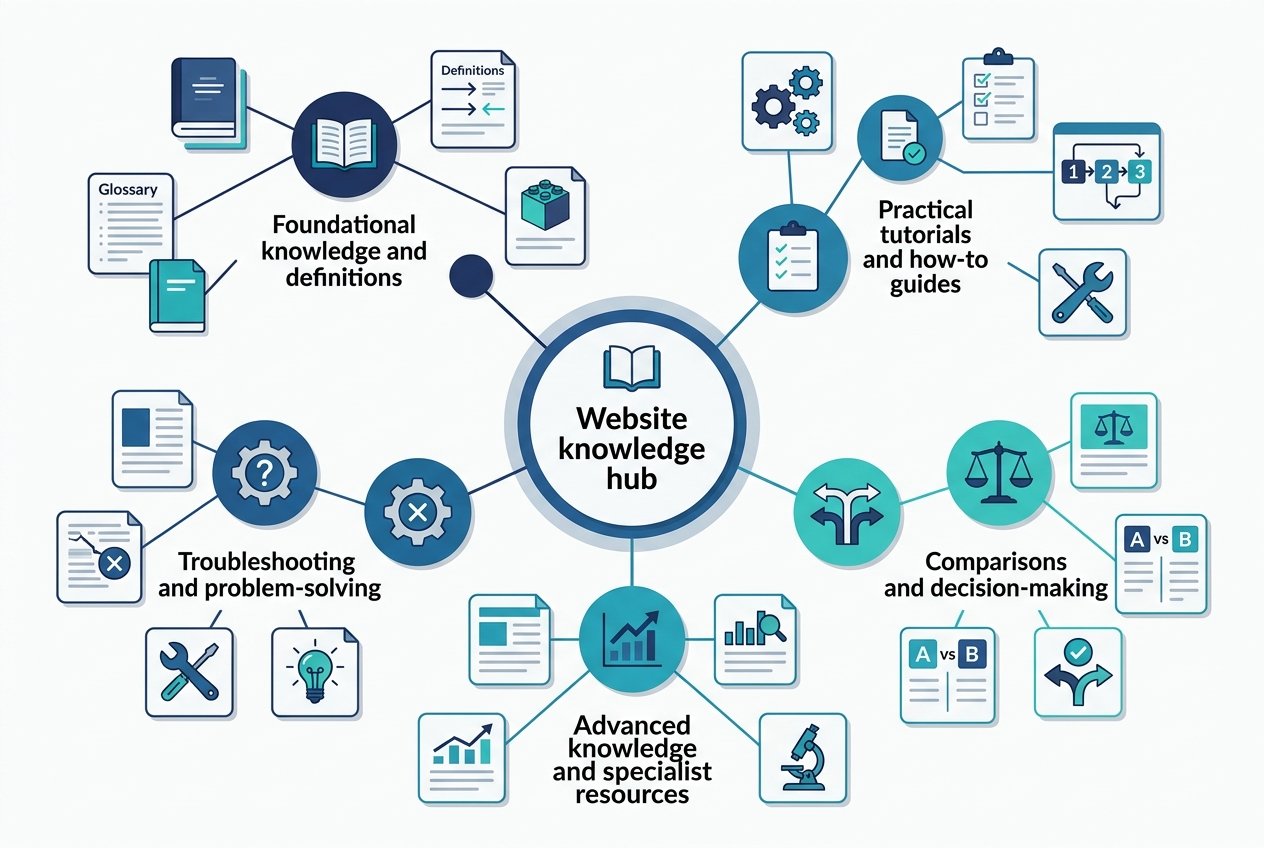
Topical authority is the degree to which a website is understood by its audience—and potentially by search systems—as a useful, reliable source on a defined subject. It comes from the combined quality, relevance, breadth, and organization of the site’s content, not from one page or one keyword.
Imagine a website about home gardening. One article about tomato plants may answer a narrow question. A more complete resource library could also explain soil preparation, watering, pruning, container growing, pests, seasonal planning, composting, and harvesting. If these pages are accurate, useful, written for the same audience, and connected through clear navigation and contextual links, the site gives readers a more complete learning path.
This does not mean every website must cover every possible subtopic. A specialist site about balcony vegetable gardens may be more coherent by covering that area deeply than by publishing generic articles about all forms of gardening. The right scope depends on the site’s purpose, audience, expertise, and resources.
Topical authority versus domain authority
Domain authority is commonly used as a third-party metric to estimate a site’s link-based strength. Different SEO platforms calculate their own versions; it is not a Google score. Topical authority is a broader editorial and audience concept: how well a site serves a subject through relevant knowledge, content, and connections. A site may have a modest backlink profile but serve a narrow topic exceptionally well. Conversely, a site with many backlinks may publish a scattered collection of pages that does not provide a satisfying resource for a particular audience. Neither observation guarantees rankings.
Is topical authority a direct Google ranking factor?
Do not treat topical authority as a publicly confirmed, standalone Google ranking factor or a measurable score that Google publishes. Google describes ranking systems as using many signals to identify helpful, reliable content. Its guidance encourages people-first pages that demonstrate original value, satisfy visitors, and make the creator and purpose clear. E-E-A-T—experience, expertise, authoritativeness, and trustworthiness—is a framework for evaluating quality concepts, not a single ranking factor by itself. Google’s guidance on helpful, reliable, people-first content is a useful editorial standard.
Why Topical Authority Matters
A well-organized content library can benefit readers and improve the way a website manages its content. These are strategic advantages, not promises of a particular ranking result.
- More complete answers: Readers can move from an introduction to detailed explanations without restarting their research.
- Clearer site focus: Visitors can understand what the website covers and whether it is relevant to them.
- Better internal discovery: Contextual links help people and crawlers find related resources, including pages that might otherwise be buried.
- Smarter content planning: Topic maps expose missing explanations, duplicated articles, and opportunities to update existing pages.
- Editorial consistency: Writers can work from shared definitions, sources, standards, and audience needs.
- Broader relevant query coverage: A genuinely useful resource library may answer many related questions, including specific queries that were not the primary target of one page.
These benefits depend on quality and relevance. Thin pages, repetitive keyword variations, and unrelated posts can make the site harder to navigate and maintain. More content is not automatically better content.
How to Build Topical Authority: 10 Practical Steps
Step 1: Choose a focused topic that fits your website.
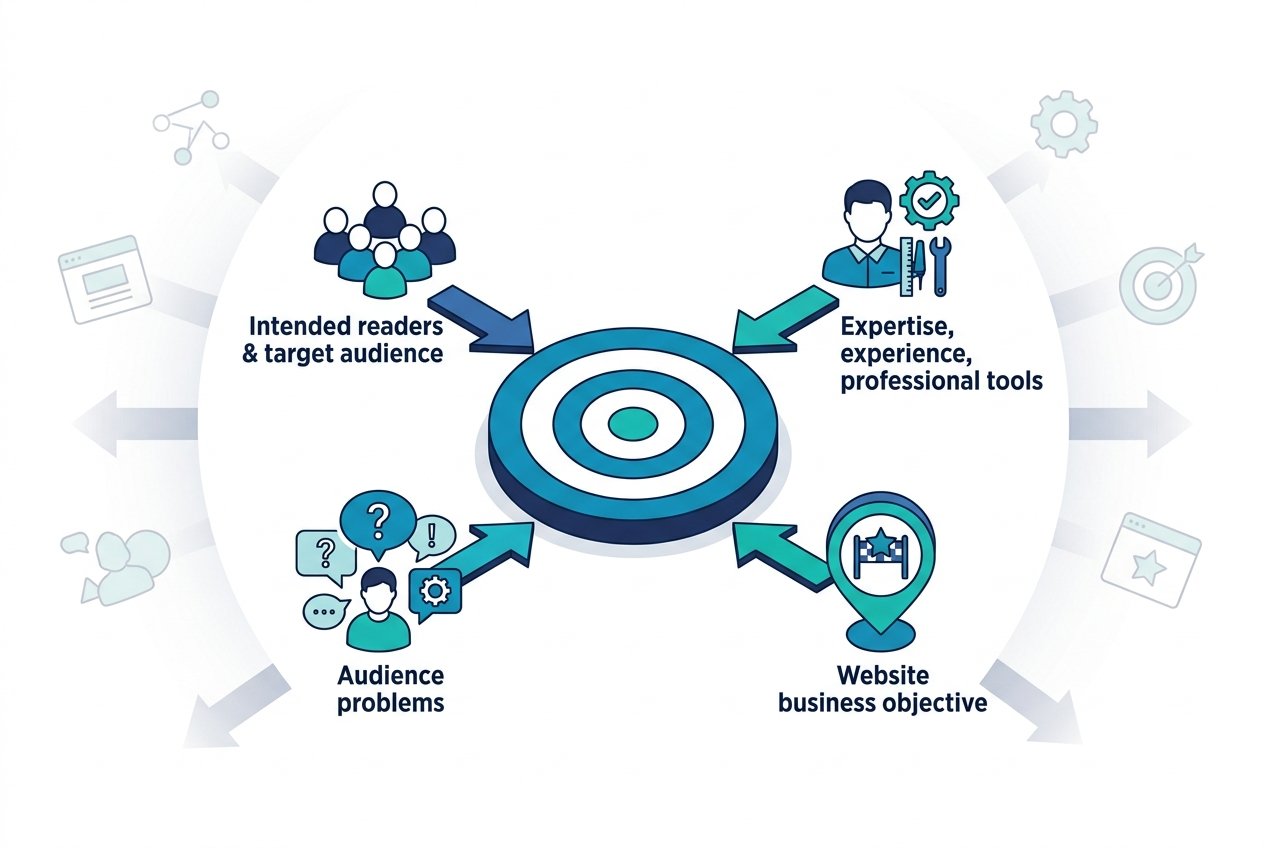
Start with the audience and purpose of your website, not a list of high-volume keywords. Your core topic should sit close to the problems you can credibly help people solve. Ask who the intended audience is, what recurring questions they have, what knowledge or experience the site can contribute, and whether the subject can support meaningful subtopics without becoming unfocused.
For example, “marketing” may be too broad for a small specialist blog. “Email marketing for independent online retailers” is narrower and easier to connect to a defined audience. It can still support list building, welcome sequences, segmentation, deliverability, campaign planning, measurement, and compliance.
Write a one-sentence topical promise, such as “This site helps independent retailers plan, send, and improve useful email campaigns.” Use it as a filter when deciding whether a proposed article belongs in the content plan.
Step 2: Understand the audience’s search journey
People search differently depending on what they know and what they are trying to do. A beginner may ask, “What is email segmentation?” while an experienced marketer may search for “how to segment repeat-purchase cohorts.” A buyer may compare tools, while an existing customer may need troubleshooting instructions.
Map questions across five stages: awareness (recognizing a problem), understanding (learning definitions and principles), implementation (following instructions), evaluation (comparing methods or tools), and improvement (measuring results and troubleshooting). This prevents a content plan from consisting only of introductory definitions or only of advanced tutorials. It also helps you choose the right format: a “what is” query needs a clear explanation, a “how to” query needs a sequence of actions, and a comparison query needs consistent criteria.
Step 3: Research the full topic, not just the main keyword.
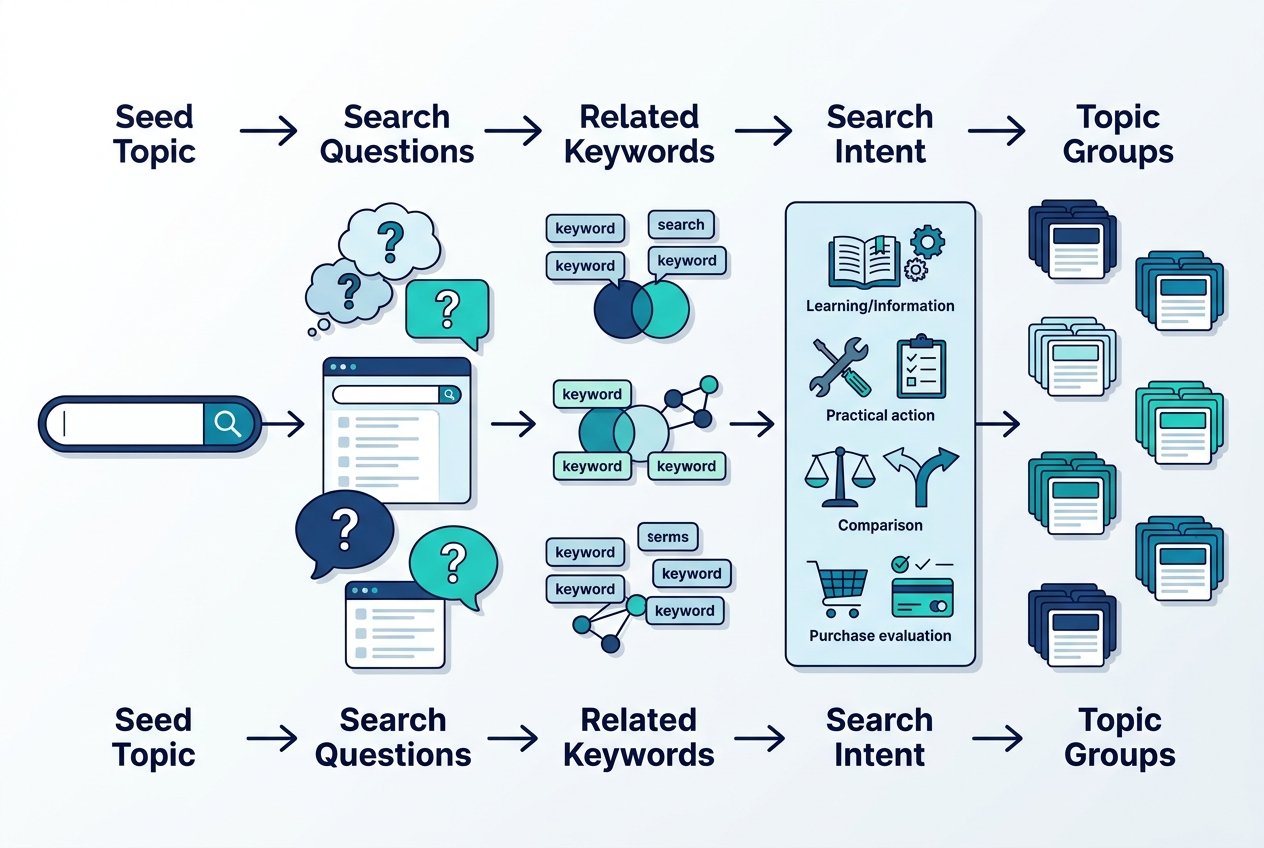
Begin with a seed phrase that represents the subject. Expand it using keyword research, search suggestions, related questions, customer conversations, support requests, relevant forums, competitor pages, and your own analytics. The purpose is not to collect every phrase that contains the seed keyword. It is to understand the important concepts and tasks within the subject.
Group findings into foundational concepts, how-to tasks, problems and troubleshooting, comparisons and decisions, tools and resources, and advanced topics. For every candidate topic, record its likely intent, intended reader, unique value you can add, and the page that should answer it. If several keywords express the same need, they may belong on one page. If the intents are meaningfully different, separate pages may be justified.
Use a repeatable keyword process rather than guessing. Makhan.org’s guide to keyword research in 2026 supports the research stage, while the keyword research strategy guide provides additional context for planning and prioritization.
Step 4: Analyze competitors for gaps, not for copying.
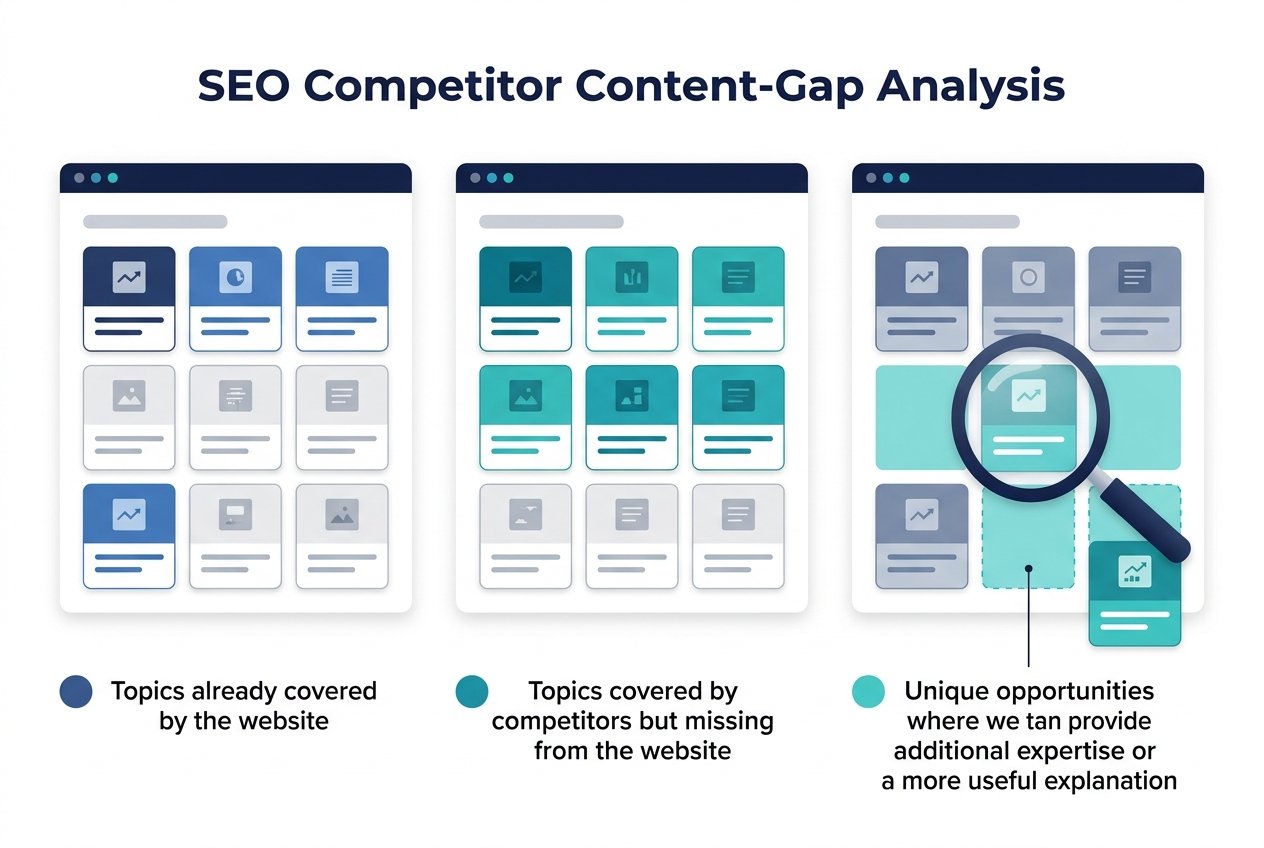
Review pages that perform well for the queries you want to serve. Examine the questions they answer, the depth of explanation, the formats they use, the sources they cite, and the reader problems they leave unresolved. Include specialist sites that may not be direct commercial competitors but compete for the same informational searches.
Create a gap list: missing coverage (a useful subtopic your site does not address), weak coverage (an existing page that is outdated or incomplete), and distinctive opportunity (a question where your expertise, process, data, or examples can add something competitors do not provide). Do not assume a competitor’s page is correct simply because it ranks. Verify important claims against primary documentation. Record what your page will contribute rather than reproducing competitor headings or structures.
Step 5: Build a topical map.
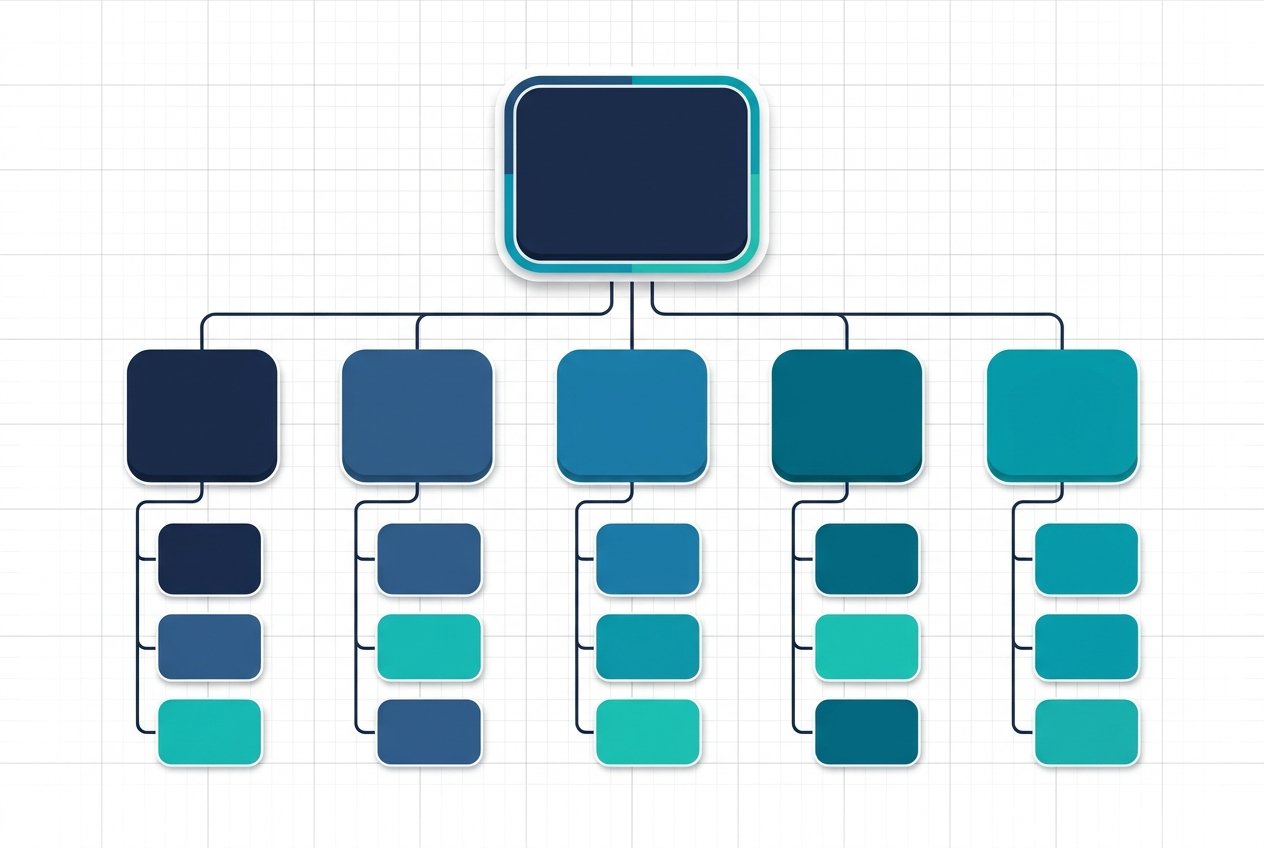
A topical map is an organized outline of the main subject and its supporting subtopics. It turns research into an editorial plan. A simple map has three levels: the core topic, major topic clusters, and supporting pages that answer specific questions.
| Cluster | Supporting page ideas | The reader needs |
|---|---|---|
| List building | Opt-in forms, lead magnets, signup placement, consent basics | Grow a relevant subscriber list. |
| Campaign planning | Campaign calendar, subject lines, promotional sequences | Plan and send campaigns |
| Segmentation | Customer groups, purchase behavior, engagement segments | Send more relevant messages. |
| Deliverability | Authentication, bounce handling, spam complaints | Diagnose delivery problems. |
| Measurement | Click tracking, conversion measurement, campaign analysis | Understand and improve performance |
For each proposed page, record its primary intent, target audience, format, parent cluster, internal links, evidence required, and status. Map existing URLs too. Without this step, you may commission a new article even though an older page already serves the same purpose.
Keep the map selective. A subtopic deserves its own page when it has a distinct reader need and enough useful material to justify a separate resource. If two ideas are nearly identical, combine them. Ahrefs’ guide to building an SEO topical map offers another practical planning model.
Step 6: Audit existing content before creating more
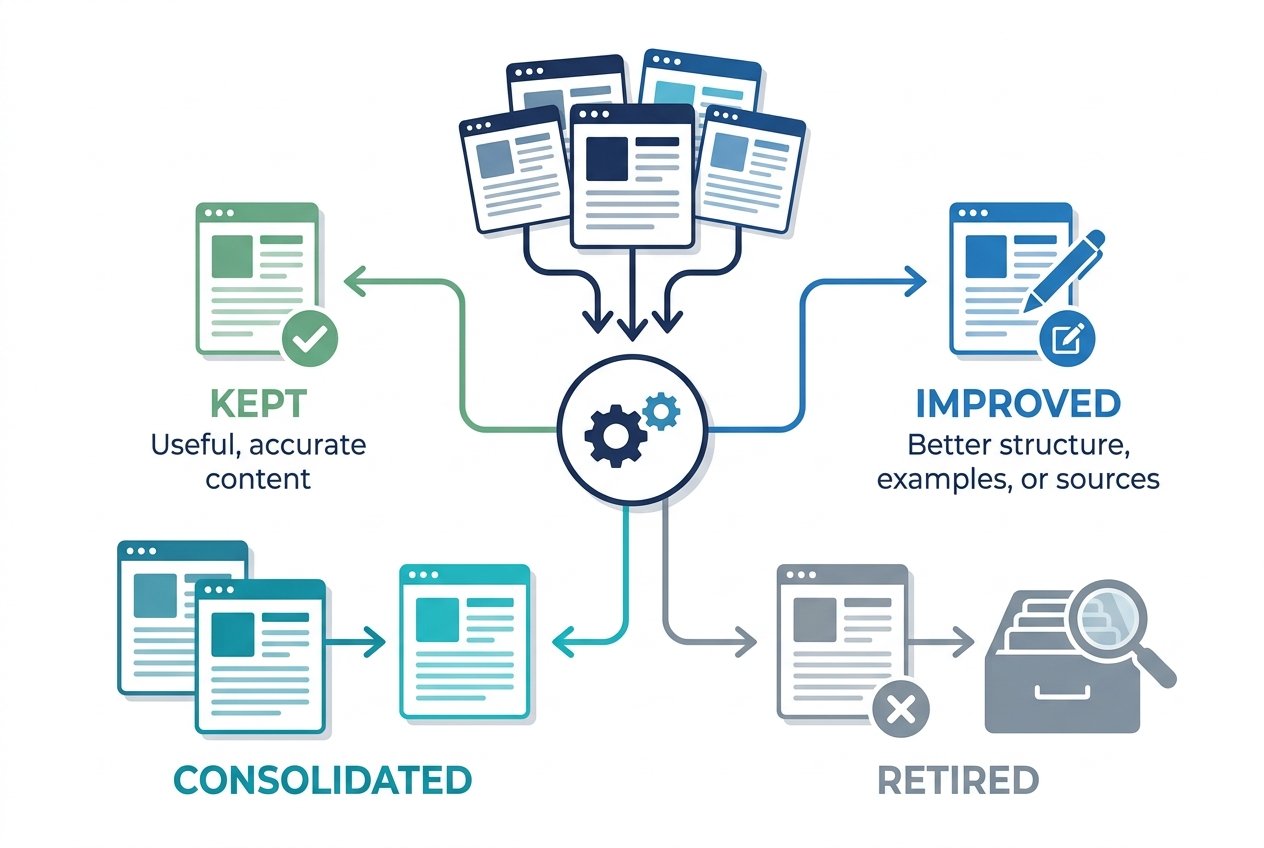
Inventory the pages already on your website. A spreadsheet is sufficient for a small site. Include URL, title, topic cluster, primary intent, last meaningful update, traffic or engagement indicators where available, backlinks where available, and recommended action.
Assign each page one of four actions:
- Keep: It serves a distinct intent and remains accurate and useful.
- Improve: It needs better coverage, examples, sources, links, or formatting.
- Consolidate: Multiple pages overlap substantially and would serve readers better as one stronger resource. Plan redirects before removing URLs.
- Retire: It no longer serves the audience or site purpose. Review links, traffic, and redirect needs first.
Do not merge pages solely because they share a keyword. Compare the actual search intent and the questions each page answers. Two pages can mention the same phrase but serve different needs. Conversely, two pages with different titles may compete because they answer almost the same question. For larger sites, use Search Console, analytics, and a site crawl to identify orphaned pages and overlapping query coverage. Metrics can flag a page for investigation; they cannot decide its editorial value on their own.
Step 7: Plan pillar pages and supporting content
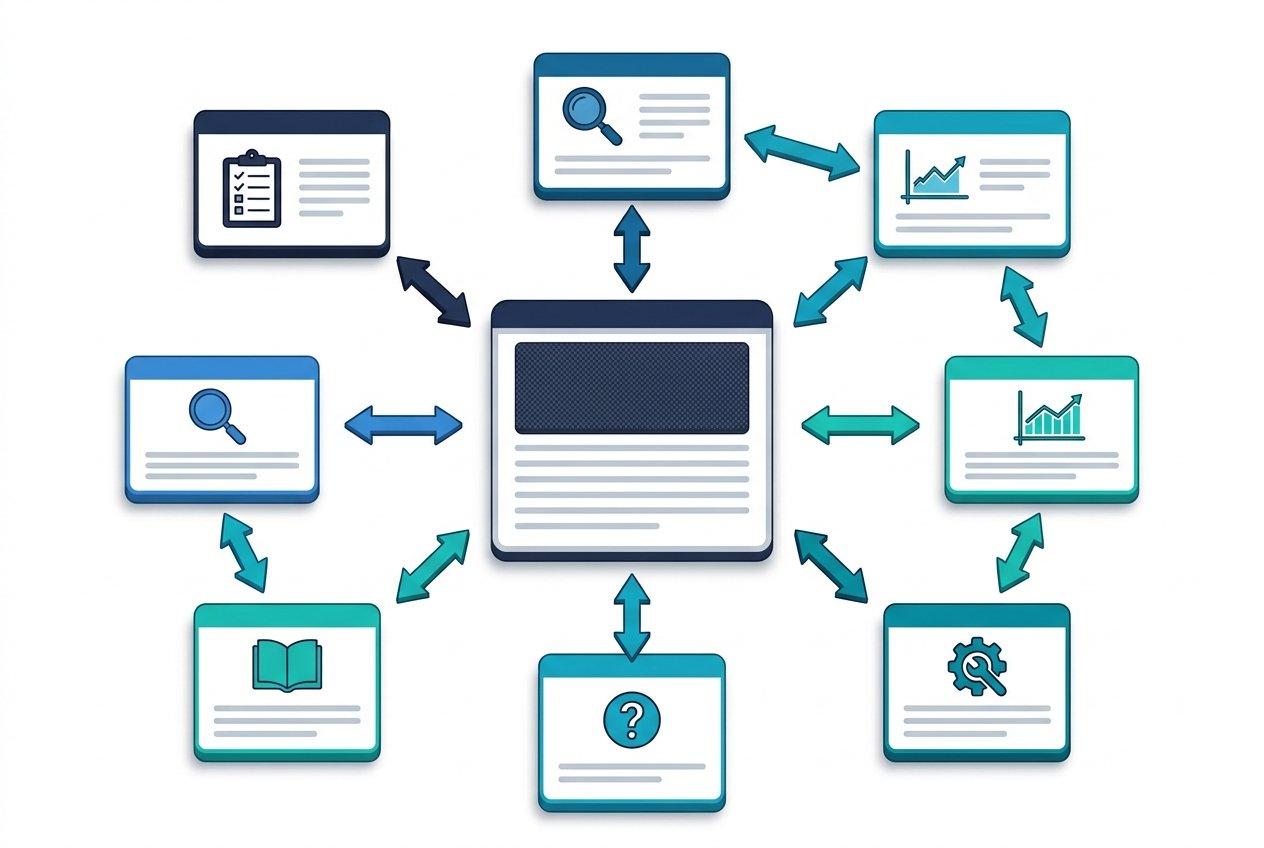
A pillar page gives readers a broad, organized introduction to a major cluster. Supporting pages answer narrower questions in greater depth. The pillar should not attempt to contain every detail. It should explain the overall subject, help readers choose the next step, and link to the detailed resources that expand each part.
For example, a pillar page about email deliverability might explain what deliverability means, why authentication matters, the role of sender reputation, common causes of delivery problems, and the main diagnostic steps. Separate supporting pages could cover SPF, DKIM, DMARC, bounce types, spam complaints, and troubleshooting a sudden decline.
Choose the format based on intent, not a fixed template. A cluster may need a tutorial, glossary, checklist, case analysis, comparison, or reference page. Some topics are better served by a concise answer than a long article. Google cautions against writing to an assumed preferred word count; the right length is the length needed to satisfy the reader. Publish the pillar and highest-priority supporting resources first, then expand based on user needs and performance data.
Step 8: Create genuinely useful, evidence-based content
Each page should have a clear purpose and a defined reader. Before writing, establish the question or task, what the reader already knows, what they should understand after reading, what evidence supports the explanation, what competing resources miss, and which related pages should be linked next.
Use first-hand experience where it exists. If you tested a process, explain what you tested and under what conditions. If you did not test it, do not imply that you did. If a claim comes from documentation or research, cite the source and make the limits clear. Add screenshots, original diagrams, examples, or templates only when they help explain the subject.
Give readers the answer early, then add the reasoning and details. Define technical terms when they first appear. Use headings that describe the section accurately. Keep paragraphs focused and remove repeated explanations. A useful article is not necessarily the longest article; it is the one that helps the intended reader complete the task with confidence. Google’s SEO Starter Guide recommends useful, unique, well-organized content and descriptive link text.
Step 9: Connect the cluster with contextual internal links
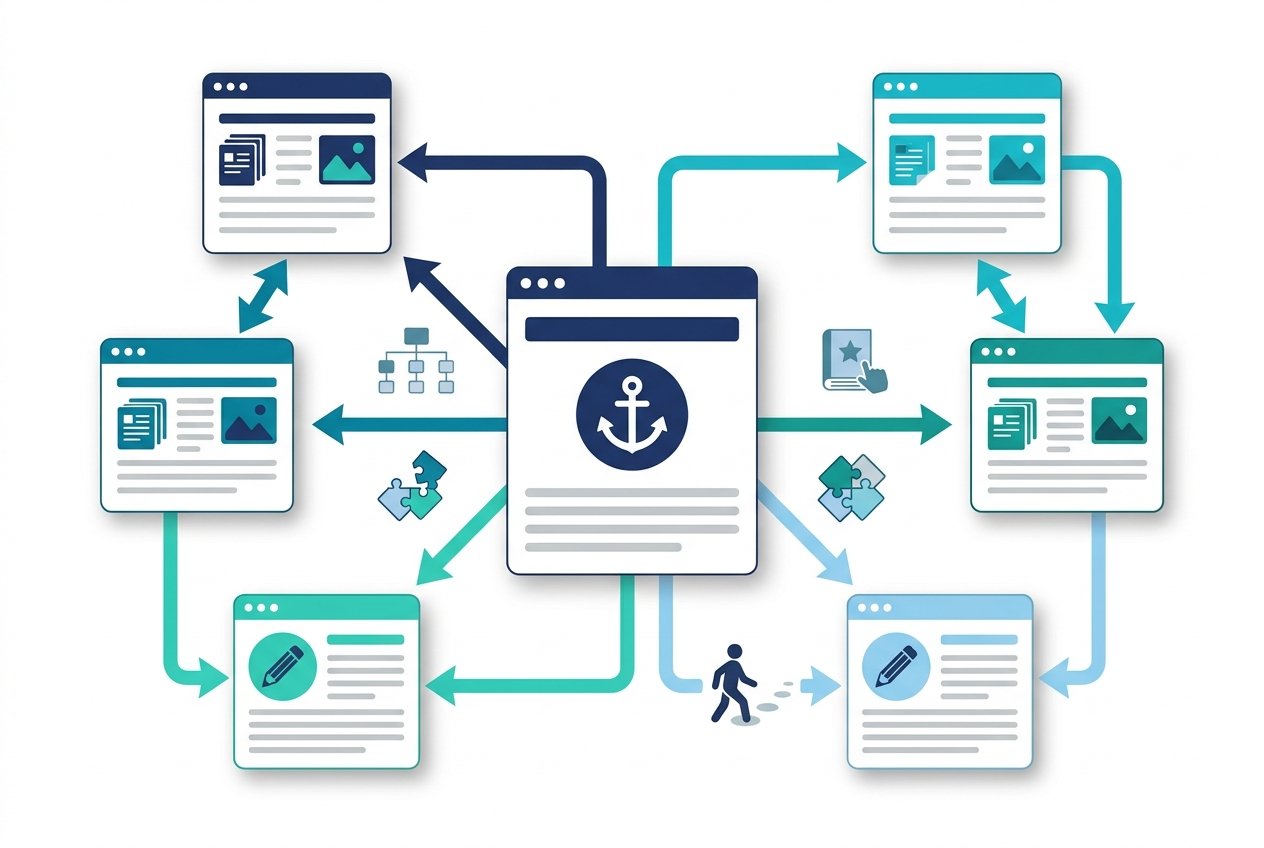
Internal links help readers move between related explanations and help crawlers discover pages and understand relationships. Google recommends crawlable links and meaningful anchor text, and advises linking to other pages when useful rather than chasing a fixed number of links.
Use several link directions: the pillar links to supporting pages; supporting pages link back to the pillar when readers need wider context; related supporting pages cross-link when the next resource genuinely helps; and older pages link to new resources when they fill a real gap.
Place links in the sentence where the related resource becomes useful. Use anchor text that describes what readers will find. Avoid vague phrases such as “click here,” repeated exact-match anchors, or blocks of unrelated links added only to increase link count. For Makhan.org, this article should connect naturally with the existing guides on internal linking in SEO and optimizing internal links. Those pages cover link mechanics in more detail; this guide explains how internal links support a broader topical structure.
Step 10: Demonstrate trust, build reputation, and maintain the cluster
Trust is not created by adding the letters E-E-A-T to a page or repeating claims about being an expert. It is built through accurate information, transparent authorship, sound sourcing, and evidence that the content has been prepared with care. Use accurate bylines, explain relevant experience without exaggeration, cite primary documentation, show how tests or recommendations were produced when that context matters, correct errors, and disclose commercial relationships clearly.
Google’s people-first guidance encourages publishers to make clear who created content, how it was produced when relevant, and why it exists. It warns against producing content primarily to attract search traffic or summarizing other sources without adding meaningful value. Review the official helpful content guidance when setting editorial standards.
Beyond your website, relevant mentions, citations, collaborations, and links from trusted sources can help people discover and evaluate your work. Contribute useful explanations to industry publications, participate in professional communities, publish original research, and create resources that others may reference. Avoid paid link schemes, automated exchanges, irrelevant guest posts, and mass outreach that offers no reader value. If a link is paid or sponsored, qualify it appropriately.
Finally, maintain the cluster. Products change, standards evolve, tools are redesigned, and reader questions shift. Set a review cadence based on the topic’s rate of change. Review content when source documentation changes, examples become outdated, search queries reveal a new need, a page overlaps with a newer article, or performance changes materially. Make meaningful updates rather than changing dates to make pages look fresh. Keep a record of what changed and why.
How to Measure Progress Without Chasing a Fake Authority Score
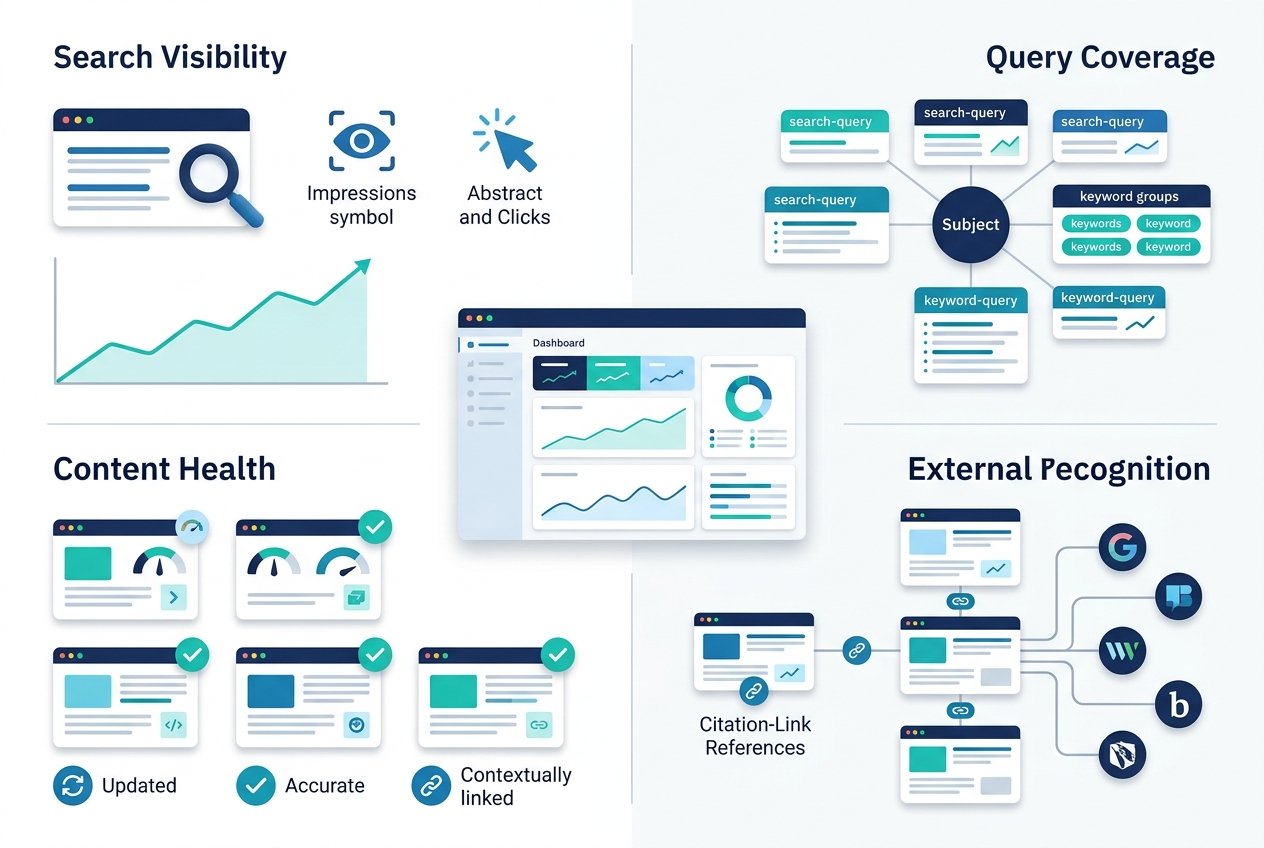
There is no universal topical-authority score in Google Search Console. Avoid treating a third-party metric or an internally invented score as proof that Google considers your site authoritative. Instead, measure outcomes that reflect a healthier content system.
Search visibility and query coverage
Use Google Search Console to review impressions, clicks, average position, and the queries associated with each important page or cluster. Look for whether relevant pages begin appearing for a broader set of appropriate questions. Segment by page and topic rather than relying only on total site traffic.
Engagement and task completion
Use analytics and qualitative feedback to understand whether visitors continue to related pages, use resources, complete key actions, or return to the site. Interpret engagement metrics in context: a page that answers a question immediately may have a short session and still be successful.
Internal-link and content health
Audit for orphaned pages, broken links, excessive click depth, and missing connections between pages that should form a cluster. Track whether priority pages have current sources, clear ownership, and accurate examples. Record updates and consolidations so the content library becomes more coherent over time.
Relevant external recognition
Review links and mentions from relevant organizations, publications, professional communities, and creators. Evaluate the context and quality of those references, not just the raw number. A relevant citation that sends interested readers may be more useful than many unrelated links.
Use these indicators together. A single month’s ranking change does not prove that a topical strategy worked or failed. Search visibility fluctuates for many reasons, so evaluate patterns over an appropriate period and investigate individual pages before concluding.
Common Topical Authority Mistakes to Avoid
- Publishing too broadly: Writing about every trending subject can make the site less coherent. Keep the topical promise visible and reject ideas that do not serve the audience.
- Creating a page for every keyword variation: Near-duplicate pages can compete for the same intent. Group similar queries when one strong page can answer them naturally.
- Confusing word count with depth: Long content can still be shallow if it repeats definitions and avoids the reader’s task. Cover the subject sufficiently and stop when the page has done its job.
- Building clusters without links: Add contextual links as each page is published and revisit older pages when new resources become available.
- Copying competitor coverage: Competitor research should reveal expectations and gaps, not provide a blueprint to reproduce.
- Ignoring old content: New articles do not automatically fix outdated or conflicting information. Audit the existing library and improve, consolidate, or retire pages where appropriate.
- Treating E-E-A-T as cosmetic: Author boxes and citations cannot make unsupported claims trustworthy. Demonstrate real experience where relevant and use accurate sourcing.
- Measuring only rankings: Combine Search Console data with content audits, internal-link analysis, and user feedback.
Conclusion: Build a Useful Resource, Not Just a Larger Blog
Building topical authority in SEO starts with a clear subject and a real audience need. Research the questions people ask, organize them into sensible clusters, audit what you already have, and create pages that add reliable value. Then connect those resources with contextual internal links, demonstrate expertise honestly, and maintain the library as the subject changes.
For Makhan.org, this approach should complement—not duplicate—the existing resources on Google E-E-A-T and organic search authority, keyword research, and internal linking. Use each supporting guide for its specific task, while this article serves as the overall framework for planning and connecting a topical content library.
The most useful next step is to choose one core topic on your website and map the pages that already exist before commissioning anything new. A focused, well-maintained collection of resources is a stronger foundation than a large archive of disconnected posts.
A Worked Example: Turning a Topic Into a Content Cluster
Suppose a small website helps independent retailers improve email marketing. Its topical promise is clear: practical guidance for planning and improving customer email. The team chooses “email marketing strategy” as a broad subject, then groups research into list growth, campaign planning, segmentation, deliverability, and measurement. Before commissioning new posts, it maps existing URLs and discovers that it already has a useful beginner guide and a separate deliverability tutorial.
The team keeps those pages, updates one with current examples, and plans a pillar page that introduces the full workflow. It then prioritizes a supporting guide on customer segmentation because readers repeatedly ask how to separate new subscribers from repeat buyers. The segmentation article links to the pillar for context, to the list-building guide for acquisition questions, and to the measurement guide for evaluating campaign outcomes. The pillar links back to each supporting resource in the relevant section.
After publication, the team checks Search Console queries and reader feedback, reviews whether visitors can find the next useful step, and schedules a content review when the email platform or relevant requirements change. This is topical authority work in practice: not publishing every possible keyword, but building and maintaining a connected set of resources around a real audience need.
Final Takeaway
Choose a topic you can serve credibly, map the questions that matter, improve what already exists, and publish only the pages that add distinct value. Connect them with helpful links and maintain them over time. That is the practical foundation of a trustworthy topical resource.